SBI PO vs IBPS PO vs RBI Grade B: Which One Should You Choose?

8th May 2026

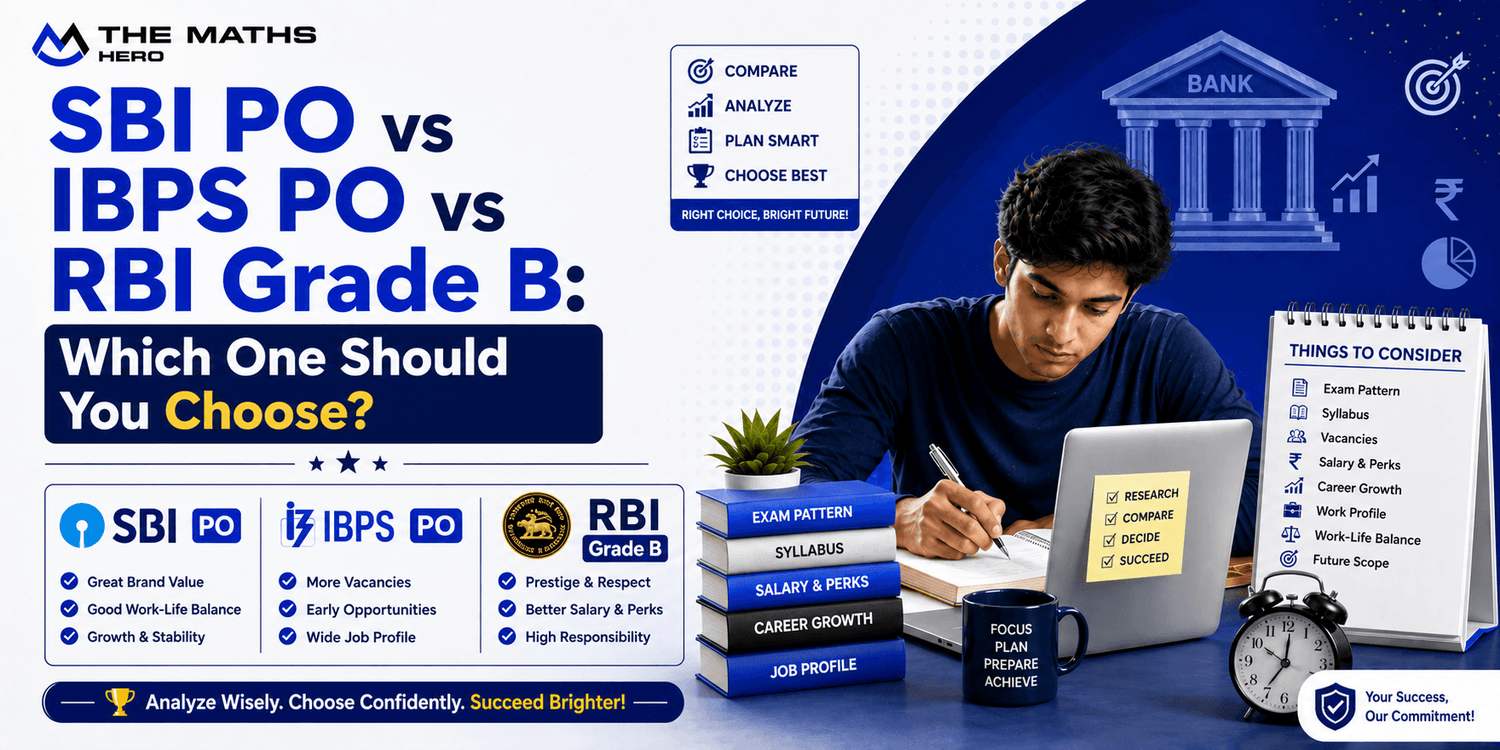
You don’t really struggle with starting the preparation, but you struggle with deciding where to actually put your effort, and that is where you get confused.
One day you are solving mocks for bank PO exams, and you feel like it is going fine, but then someone tells you that RBI Grade B is better because of the salary and the lifestyle, so that creates doubt. And then again, you hear that SBI has faster career growth in banking, but IBPS gives more stability. And therefore, you are not sure what to believe and what to choose – SBI PO vs IBPS PO vs RBI Grade B.
This confusion has been very common among aspirants because all three look similar at first (government job, stable career, secure future) but when you look closer, they are not the same, in fact, exam pattern, job profile, salary and even the career growth quite differ from each other.
So it’s not just an exam choice, it is a career decision, and therefore it becomes important that you understand what actually fits you, and what does not.
SBI PO vs IBPS PO vs RBI Grade B: Selection process compared
The selection process is not just about clearing stages, but it also reflects what the job demands from you. While SBI and IBPS focus more on speed and accuracy, RBI looks for depth and clarity. And that difference starts showing right from the selection stages itself.
| Stage | SBI PO | IBPS PO | RBI Grade B |
| Stage 1 | Prelims (Objective) | Prelims (Objective) | Phase 1 – Prelims (Objective) |
| Stage 2 | Mains (Objective + Descriptive) | Mains (Objective + Descriptive) | Phase 2 – Mains (Objective + Descriptive) |
| Final Stage | Interview + Group Exercise | Interview | Interview |
| Focus Area | Speed + Decision-making | Speed + Accuracy | Conceptual clarity + Writing skills |
| Overall Approach | Competitive and dynamic | Structured and moderate | Analytical and in-depth |
The key difference, therefore, is that RBI does not just test how fast you solve, but also how well you understand and express.
SBI PO vs IBPS PO vs RBI Grade B: Exam pattern breakdown
The exam pattern shows what kind of preparation is actually required and also what the role expects from you later. Like SBI and IBPS are more about speed and accuracy but RBI focuses more on understanding and expression. So the approach, therefore, cannot be the same.
| Section / Stage | SBI PO | IBPS PO | RBI Grade B |
| Prelims | Quant, Reasoning, English | Quant, Reasoning, English | Quant, Reasoning, English, General Awareness |
| Prelims Duration | 60 Minutes | 60 Minutes | 120 Minutes |
| Mains (Objective) | Quant, Reasoning, English, General Awareness | Quant, Reasoning, English, General Awareness | Economic & Social Issues, Finance & Management |
| Mains (Descriptive) | English (Essay & Letter) | English (Essay & Letter) | English (Descriptive Writing) |
| Focus Type | Speed + Accuracy | Speed + Accuracy | Conceptual Understanding + Writing |
| Nature of Exam | Time-bound and competitive | Structured and moderate | Analytical and knowledge-driven |
So while SBI and IBPS reward quick solving, RBI expects you to think, write, and explain clearly and that changes the preparation entirely.
SBI PO vs IBPS PO vs RBI Grade B: Salary comparison
A salary is typically the first thing you’ll research; this makes sense, as it indicates both your job’s position and responsibility as well as what kind of lifestyle you may lead. If you look at your compensation in terms of a salary comparison, with SBI vs IBPS vs RBI, you will find many differences; not only do their salaries differ, but their total compensation packages provide various benefits and perks. Therefore you should take into account more than just the monthly pay you are going to get.
| Component | SBI PO | IBPS PO | RBI Grade B |
| Starting Salary (Approx.) | ₹65,000–₹70,000/month | ₹55,000–₹60,000/month | ₹1,00,000+ per month |
| Basic Pay | Higher than IBPS PO | Moderate | Highest among all three |
| Allowances | HRA, DA, Travel, Medical | HRA, DA, Medical | HRA/Leased Housing, DA, Medical, Education |
| Perks | Loan benefits, insurance | Standard banking perks | Housing, fuel, education, medical, allowances |
| Overall Compensation | High | Moderate | Very High |
As per the official salary structures, RBI Grade B officers have been receiving the highest compensation, and it also includes housing and medical benefits, so that makes it quite attractive. But at the same time, salary alone is not everything, because the work pressure, and the career growth in banking, and the daily routine, they all are important too and therefore, you should not decide only based on numbers.
SBI PO vs IBPS PO vs RBI Grade B: Career growth compared
Career growth is not just about how fast you get promoted, but also about where that path is taking you, and what kind of roles you step into over time. And when you look at the career growth in banking, you will see that each option follows a different direction, therefore the choice depends on what you value more.
| Factor | SBI PO | IBPS PO | RBI Grade B |
| Promotion Speed | Faster | Moderate | Slower |
| Competition | High internal competition | Depends on bank | Limited but selective |
| Role Progression | Early leadership roles | Gradual role expansion | Senior policy-level roles |
| Exposure | Branch + operational exposure | Bank-specific exposure | National financial system exposure |
| Growth Type | Fast and dynamic | Stable and steady | Strategic and high-level |
So growth is not just about speed, but also about the kind of career you are building, because you may grow fast in SBI, but you may grow differently in RBI and that difference matters.
SBI PO vs IBPS PO vs RBI Grade B: Job profile compared
This is the part many candidates overlook, but it actually defines your daily life, and how your work feels over time. The bank PO job profile is not the same across all roles, and therefore you should understand what you will actually be doing.
| Aspect | SBI PO | IBPS PO | RBI Grade B |
| Nature of Work | Operational + managerial | Operational | Analytical + regulatory |
| Key Responsibilities | Customers, loans, targets | Banking operations, services | Policy, research, financial systems |
| Work Environment | Branch-based, dynamic | Bank branch environment | Office-based, structured |
| Customer Interaction | High | High | Minimal |
| Work Style | Quickly changing and target-driven | Balanced | Analytical and research-driven |
So while SBI and IBPS roles are people-facing and operational, RBI is more about thinking and analysis. Therefore the experience feels completely different even though all three are in banking.
SBI PO vs IBPS PO vs RBI Grade B: Exam difficulty compared
If you think bank exam difficulty is just about how hard the paper is, then you’re right, but remember, it is also about what it expects from you, and how you prepare for it. And when you compare these exams, you will notice that they are not equal in terms of depth.
| Exam | Difficulty Level | Nature of Difficulty |
| IBPS PO | Moderate | Speed and accuracy focused |
| SBI PO | Moderate to Difficult | Speed + decision-making |
| RBI Grade B | Difficult | Conceptual depth + descriptive skills |
RBI is not just tough because of competition, but because it requires deeper understanding, and you cannot rely only on shortcuts or tricks, so that makes preparation more demanding.
SBI PO vs IBPS PO vs RBI Grade B: Which one should you choose?
| Factor | SBI PO | IBPS PO | RBI Grade B |
| Salary | High | Moderate | Very High |
| Work Pressure | High | Moderate | Moderate (intellectual) |
| Transfers | Frequent | Moderate | Limited |
| Growth Speed | Fast | Moderate | Slow but prestigious |
| Work Type | Operational | Operational | Policy & Research |
| Exam Difficulty | High | Moderate | Very High |
Now at this point, the comparison is clear but the decision is still personal. Because what works for someone else may not work for you, so rather than looking for the “best” option, you should focus on the right fit, and the right fit depends on your preferences, your strengths, and the kind of career you actually want.
Choose SBI PO if:
- You enjoy interacting with people, and you are comfortable handling customers daily
- You are okay with targets and pressure because the role demands performance and consistency
- You want faster promotions, and you are willing to compete internally to grow quickly
- You like dynamic, on-ground roles, where every day is different and sometimes unpredictable
Choose IBPS PO if:
- You want a balanced work environment, and you prefer moderate pressure compared to SBI
- You are looking for stability, because the role depends on the bank but is generally structured
- You want steady career growth in banking, without extremely high competition
- You are comfortable with operational roles, but you want slightly better work-life balance
Choose RBI Grade B if:
- You prefer analytical work, and you enjoy subjects like economics and finance
- You want a stable routine, because the work culture is more structured and less hectic
- You are interested in policy-making and the financial system, not just daily banking operations
- You value work-life balance more, and you are okay with slower but prestigious growth
There is no single “best” option, because each path offers something different, and therefore the right choice is the one that aligns with how you want your career and your daily life to look.
Preparation strategy (What actually works)
Many aspirants make the mistake of preparing for all three in the same way. That rarely works.
- For SBI and IBPS, focus on speed, accuracy, and mock tests
- For RBI, build conceptual clarity in economics and finance
- Stay consistent with current affairs for all three
And yes… having structured guidance can make a difference when things get overwhelming.
Keep in mind that you don’t need 12-hour study days. You need repeatable study days.
If you are targeting SBI specifically, exploring a SBI PO online course can help streamline your preparation.
For those focusing on multiple bank exams, an IBPS PO course often provides broader coverage across banks.
And if your goal is RBI, a dedicated RBI Grade B preparation course is almost essential due to the depth required.
To sum up
At first glance, SBI PO, IBPS PO, and RBI Grade B careers might look similar.
Government job. Banking sector. Stable future.
But once you look closer, the paths start to diverge.
One puts you in the middle of action, one gives you balance, and one places you at the heart of India’s financial system, so don’t rush the decision.
Think about how you want your daily life to look. Think about the kind of work that excites you (or at least doesn’t drain you). And then choose the path that aligns with that.
Because in the long run… the “best career” is the one you can actually sustain.
Recommended for you

Self-Study vs Online Coaching for Bank Exams: What Works Better in 2026?

Banking Quantitative Aptitude by Ashish Arora: Key Topics in Quantitative Aptitude for Bank Exams