How to prepare for banking after 12th: Complete Strategy Plan

7th May 2026

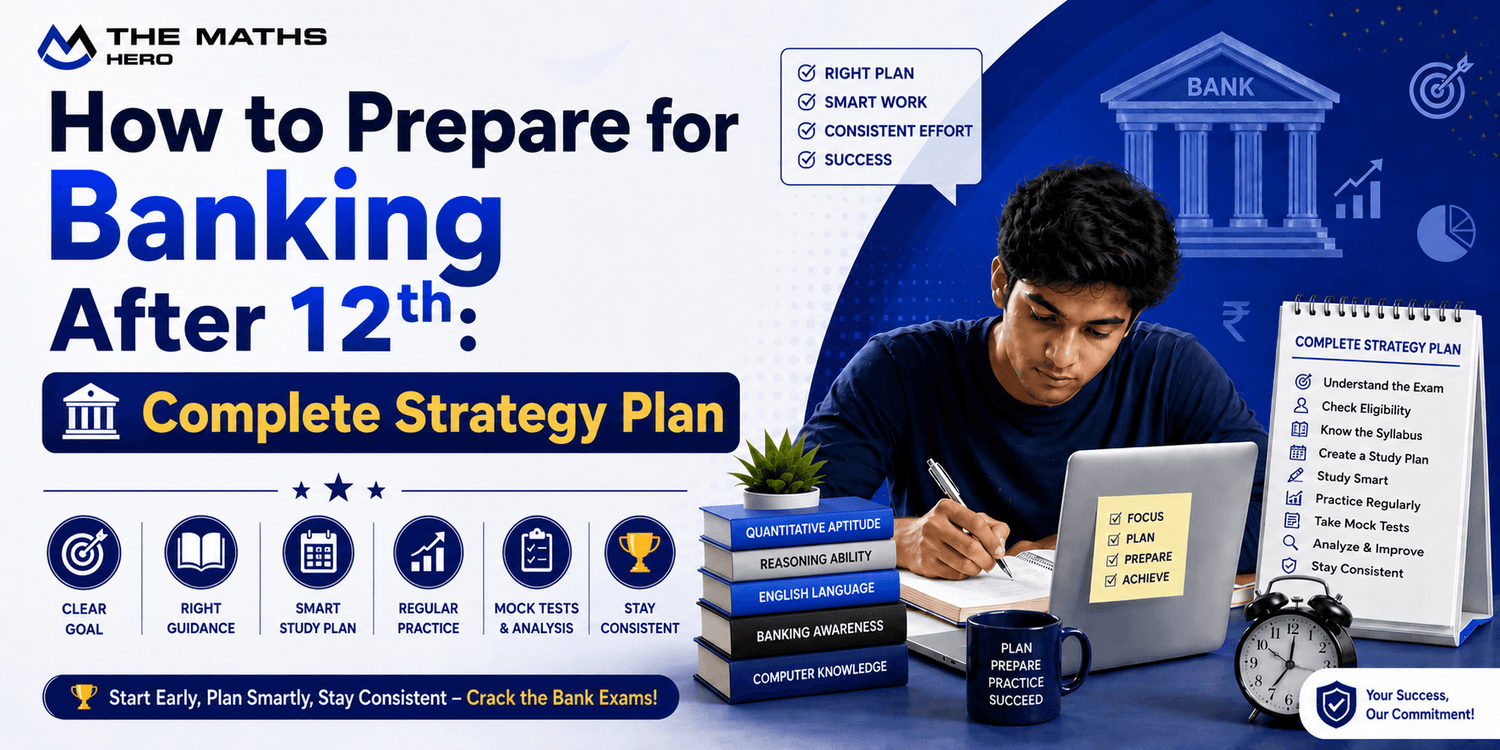
Banking jobs are one of the most valuable and stable career paths in India, offering strong growth, job security, and social respect. However, many students still assume that a graduation degree is compulsory to enter the banking sector. The truth is, while some roles require graduation, there are several opportunities and pathways where students can start preparing right after 12th itself.
In reality, banking offers multiple entry points and early preparation can give students a major advantage in cracking competitive exams later. The key is understanding the right direction at the right time.
This blog will clear all your doubts about banking careers after 12th and provide a complete end-to-end preparation strategy to help you build a strong foundation and successfully crack banking exams with confidence.
Popular Banking Exams You Should Know
Here are some of the most important banking-related exams in India:
1. RBI Office Attendant Exam
This exam is conducted by the Reserve Bank of India to recruit support staff in its regional offices for basic office work and assistance tasks. It is one of the most well-known banking-related exams for candidates after school.
Selection Process:
- Online Written Examination
- Language Proficiency Test (LPT)
- Document Verification
Basic Eligibility:
- Educational Qualification: Minimum 10th pass
- Age Limit: 18–25 years
- Must know local language of the state applied for
2. SBI Apprentice Exam
The State Bank of India conducts this exam to select candidates for apprenticeship training in banking operations under the Apprentices Act. It gives practical exposure to banking functions.
Selection Process:
- Online Written Examination
- Local Language Test (if required)
- Document Verification
Basic Eligibility:
- Educational Qualification: Graduation (not after 12th, but included as a famous SBI entry-level exam)
- Age Limit: 20–28 years
3. IBPS RRB Office Assistant Exam
Conducted by the Institute of Banking Personnel Selection, this exam is used for recruiting clerical staff in Regional Rural Banks across India, mainly for rural banking services.
Selection Process:
- Preliminary Exam
- Main Exam
- Document Verification
Basic Eligibility:
- Educational Qualification: Graduation (some notifications require graduation, so not strictly after 12th)
- Age Limit: 18–28 years
- Local language proficiency required
4. Cooperative Bank Recruitment Exams (State-wise)
These exams are conducted by different State Cooperative Banks to recruit clerical or assistant-level staff in rural and semi-urban banking operations.
Selection Process:
- Written Examination
- Interview (in some cases)
- Document Verification
Basic Eligibility:
- Educational Qualification: 12th pass or Graduation (varies by state notification)
- Age Limit: 18–30 years
- Knowledge of local language preferred
5. Banking Correspondent / CSP Selection (Bank Mitra Scheme)
This is not a traditional exam but a selection process conducted through banks or service providers to appoint Banking Correspondents for rural financial services.
Selection Process:
- Application Screening
- Interview / Training Selection
- Document Verification
Basic Eligibility:
- Educational Qualification: 12th pass
- Age Limit: 18+ years
- Basic computer and communication skills required
How to Crack Banking Exam in First Attempt – Step by Step Strategy
Step 1: Understand Exam Pattern & Syllabus
The first step of is to clearly understand what the exam demands. Knowing the pattern and syllabus helps you avoid confusion and focus only on important topics.
- Download official syllabus of Prelims and Mains
- Check previous year question papers
- Understand section-wise marks and timing
- Note important topics from each section
Step 2: Build Strong Basics
Strong basics are the foundation of banking exams. Without clear concepts, advanced questions become difficult to solve.
- Start with basic Maths concepts (percentages, ratios, etc.)
- Learn grammar rules for English
- Practice simple reasoning puzzles daily
- Use beginner-level study material
Step 3: Make a Daily Study Plan
A proper timetable helps you stay disciplined and complete syllabus on time. Consistency is more important than studying long hours randomly.
- Divide time for each subject daily
- Fix study hours and follow strictly
- Include short revision sessions
- Set small daily goals
Step 4: Practice Topic-wise Questions
Practicing questions after every topic helps you understand concepts better and improves accuracy.
- Solve 30–50 questions per topic
- Start from easy to moderate level
- Check solutions after solving
- Identify weak areas immediately
Step 5: Take Mock Tests Regularly
Mock tests simulate real exam conditions and help improve performance and confidence.
- Attempt 2–3 mocks per week initially
- Increase frequency before exam
- Analyze mistakes after every test
- Track your progress
Step 6: Improve Speed & Time Management
Speed is very important in banking exams because time is limited. Practicing shortcuts helps save time in exams.
- Practice mental calculation tricks
- Solve timed question sets daily
- Avoid spending too much time on one question
- Learn shortcut methods
Step 7: Focus on Current Affairs & Banking Awareness
This section plays a major role in Mains exam and helps in scoring high marks easily.
- Read daily news updates
- Focus on last 6 months current affairs
- Study banking terms and policies
- Revise weekly notes
Step 8: Revise Regularly
Revision helps you retain concepts for a longer time and avoid forgetting important topics.
- Revise formulas daily
- Make short notes for quick revision
- Revisit weak topics often
- Keep weekly revision schedule
Step 9: Stay Consistent & Avoid Burnout
Consistency keeps your preparation stable and effective. Overloading yourself can reduce productivity.
- Study daily without long gaps
- Take short breaks during study
- Avoid distractions like social media
- Maintain healthy routine
Step 10: Final Exam Strategy
A smart approach in the exam can improve your score significantly. Calm and planned attempts are more effective than rushing.
- Attempt easy questions first
- Skip difficult questions initially
- Avoid guesswork due to negative marking
- Manage time for each section carefully
3 Month Study Plan for Banking Aspirants
The following is the 3 Month banking career roadmap to clear competitive exam in first attempt-
| Month | Focus Area | Weekly Strategy |
| Month 1 – Foundation Building | Basics of all subjects | Week 1: Quant basics (number system, simplification)
Week 2: Reasoning basics (series, analogy, classification) Week 3: English basics (grammar, vocabulary, comprehension) Week 4: General Awareness basics (current affairs, banking terms, GK) |
| Month 2 – Concept Strengthening | Practice & topic-wise improvement | Week 5: Quant practice (percentage, profit & loss, ratio)
Week 6: Reasoning practice (puzzles, seating arrangement, coding-decoding) Week 7: English improvement (error detection, cloze test, reading comprehension) Week 8: GA + Computer awareness (banking awareness, current affairs revision) |
| Month 3 – Revision & Mock Tests | Speed, accuracy & exam practice | Week 9: Full revision of all subjects
Week 10: Daily mock tests with analysis Week 11: Speed improvement + shortcut tricks Week 12: Final revision + weak area correction |
Common Mistakes to Avoid During Banking Exam Preparation
- Starting preparation without understanding the exam syllabus and pattern
- Focusing too much on one subject while ignoring others
- Avoiding mock tests or not practicing them regularly
- Not analyzing mistakes after solving questions or tests
- Spending too much time on difficult questions during practice
- Skipping regular revision of important topics
- Relying only on theory without sufficient practice
- Ignoring current affairs and banking awareness section
- Using too many books and resources instead of limited study material
- Losing consistency and not following a daily study routine
Best Study Material for Banking Careers After 12th Class
| Subject | Best Study Material Type |
| Quantitative Aptitude (Maths) | theMathsHero material for basics, shortcuts, and practice questions |
| Reasoning Ability | Topic-wise practice sets (puzzles, seating arrangement, coding-decoding) and daily practice worksheets |
| English Language | Grammar rules practice, reading comprehension passages, vocabulary lists, and daily reading exercises |
| General Awareness / Current Affairs | Daily newspaper reading, monthly current affairs summaries, and banking awareness notes |
| Computer Knowledge | Basic computer fundamentals notes, internet & MS Office practice material, and MCQ practice sets |
| Banking Awareness | Simple notes on banking terms, RBI functions, financial awareness updates, and basic economy concepts |
Last Words
Cracking state or central level banking exams requires a smart strategy along with the right study approach. Consistent practice, clear concepts, and regular revision play a key role in success. Among all sections, Quantitative Aptitude is often the toughest for many students. This is where MathsHero helps by making concepts simpler, improving speed, and building confidence through structured practice.
If you are struggling with quant, focus on basics and practice regularly with the right guidance. With the right strategy and consistency, clearing a banking exam in your first attempt is absolutely achievable.
FAQ
Can I give banking exams directly after 12th?
Yes, a few entry-level roles like RBI Office Attendant and some banking-related positions are available after 12th, but most major exams require graduation.
Which is the best banking exam after 12th?
RBI Office Attendant is one of the most popular options after 12th for entering the banking sector.
Which is the best book for Quantitative Aptitude?
There are many options available, but for simple understanding and practice, many students prefer MathsHero as it helps in clearing basics and improving speed.
How many hours should I study daily for banking exam preparation?
Ideally, 4–6 hours of focused study daily is enough if you are consistent.
Is current affairs important for banking exams?
Yes, especially for Mains exams, current affairs and banking awareness play a crucial role in scoring.
Recommended for you

Self-Study vs Online Coaching for Bank Exams: What Works Better in 2026?

Banking Quantitative Aptitude by Ashish Arora: Key Topics in Quantitative Aptitude for Bank Exams