How to Improve Quantitative Aptitude for Bank Exams

4th May 2026

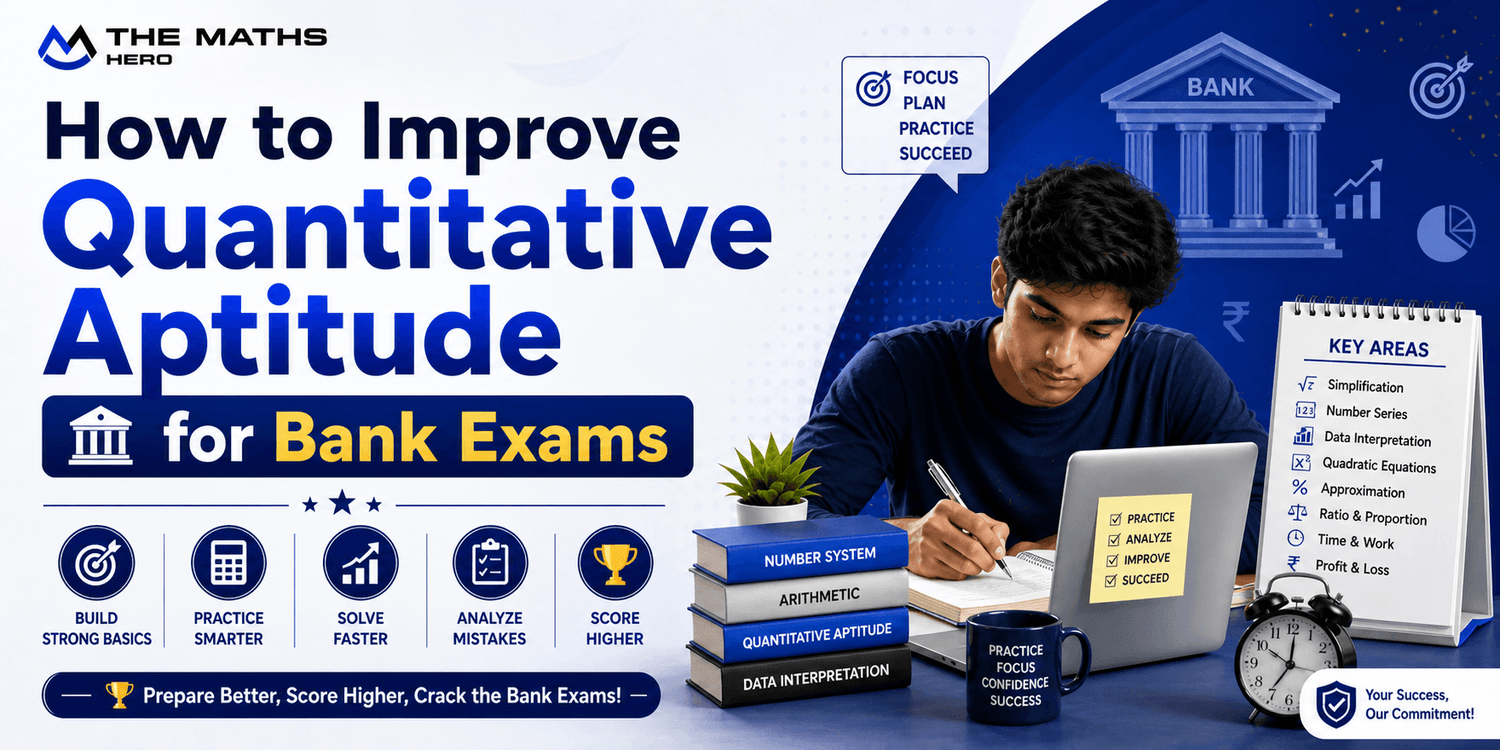
If you have started preparing for bank exams, you already know one thing: quantitative aptitude for bank exams can either increase your score big time or pull it down just as fast. It is not only about solving questions. It’s about solving them quickly, accurately, and under pressure.
The encouraging part? This is one area where progress becomes quite apparent when employing the correct methods. Let’s delineate this using straightforward, actionable guidance.
1. Start With Strong Basics (No Shortcuts Here)
Before jumping into tricks, make sure your fundamentals are clear:
- Percentages
- Ratios & proportions
- Profit & loss
- Simple & compound interest
- Time, speed, and distance
Most “hard” questions are just basic concepts twisted in a smart way. If your foundation is weak, even the best aptitude tricks for bank exams won’t help much.
Tip: Spend at least the first 7–10 days revising core concepts before moving to advanced problems.
Learn Smart Aptitude Tricks (But Don’t Depend Only on Them)
Yes, tricks save time, but only when used correctly.
Some effective aptitude tricks for bank exams include:
- Converting percentages to fractions quickly (e.g., 12.5% = 1/8)
- Using ratio shortcuts instead of long calculations
- Eliminating wrong options in MCQs
- Approximation techniques for DI and arithmetic
But here’s the catch:
👉 Tricks work best when your concepts are already clear. Otherwise, they can confuse you more.
3. Master Fast Calculation Techniques
Speed is everything in bank exams. You don’t have time for long calculations.
Focus on fast calculation techniques like:
- Tables up to 25
- Squares up to 40–50
- Cubes up to 20
- Quick multiplication methods (like Vedic math basics)
- Approximation and rounding
Example:
Instead of solving 498 × 21 traditionally, think:
👉 (500 × 21) – (2 × 21) = 10500 – 42 = 10458
Small optimizations like this can save you minutes overall.
4. Prioritize Data Interpretation (DI)
A big chunk of marks comes from DI sets. And this is where most students lose time.
To improve your data interpretation practice:
- Start with basic tables and bar graphs
- Move to pie charts and caselets
- Gradually attempt mixed DI sets (like exams)
Pro tip:
Don’t try to solve every question in a DI set. Pick the easiest ones first.
Also, practice:
- Approximation in DI
- Identifying patterns quickly
- Skipping lengthy calculations when possible
5. Practice Sectional Tests Regularly
Learning is one thing. Applying under time pressure is another.
Make it a habit to:
- Attempt 1 sectional test daily
- Analyze mistakes deeply
- Track weak topics
Focus on:
- Accuracy first
- Then speed
Without testing yourself, improvement in quantitative aptitude for bank exams stays incomplete.
6. Build a Question Selection Strategy
You don’t need to attempt all questions.
A smart attempt strategy:
- Start with easy arithmetic
- Move to simplification/approximation
- Then DI
- Skip time-consuming puzzles or lengthy questions
Remember:
👉 Selection matters more than solving everything.
7. Use Online Courses for Structured Learning
If you feel stuck or inconsistent, structured learning can help.
Well-designed online courses for bank exams provide:
- Concept clarity
- Shortcut techniques
- Mock tests and analysis
- Guided practice
They’re especially useful if:
- You’re a beginner
- You don’t know where to start
- You struggle with consistency
8. Analyze Mistakes Like a Pro
Most students practice a lot but don’t improve. Why?
Because they don’t analyze.
After every test, ask:
- Was it a concept mistake or calculation error?
- Did I waste time on a tough question?
- Could I have used a faster method?
This is where real improvement happens.
9. Stay Consistent (Even 1–2 Hours Daily Works)
You don’t need 8 hours a day. You need consistency.
A simple daily plan:
- 30 mins concepts/revision
- 30 mins practice
- 30 mins DI or mixed questions
- 30 mins test/analysis
Stick to this, and you’ll see progress within weeks.
Final Thoughts
Improving quantitative aptitude for bank exams isn’t about doing thousands of random questions. It’s about:
- Clear concepts
- Smart aptitude tricks for bank exams
- Strong fast calculation techniques
- Consistent data interpretation practice
- And the right guidance through online courses for bank exams
Get these right, and this section can become your biggest scoring advantage.
The Maths Hero: Your Shortcut to Better Quantitative Aptitude for Bank Exams
Preparing for bank exams can feel overwhelming. Especially when your performance in quantitative aptitude isn’t improving despite regular practice. That’s usually not a hard work problem, it’s a direction problem.
This is where The Maths Hero steps in. Instead of random practice, you get a structured approach that actually helps you improve step by step.
What Makes The Maths Hero Different?
- Concept Clarity First
Every topic is explained in a simple, easy-to-understand way so you not only memorize… You actually understand. - Smart Aptitude Tricks That Work in Exams
Learn practical aptitude tricks for bank exams that save time without confusing you. - Focus on Fast Calculation Techniques
Speed-building exercises designed to improve your fast calculation techniques, so you spend less time solving and more time scoring. - Targeted Data Interpretation Practice
Get structured data interpretation practice with exam-level questions and shortcuts to handle DI sets efficiently. - Practice + Strategy Combined
It’s not just about solving questions. You also learn which questions to attempt and which to skip.
Still stuck at the same score? It’s time to change how you’re preparing, start fresh with The Maths Hero.
FAQs
Which topics are important in quantitative aptitude for bank exams?
Start with arithmetic first. It is the backbone and quietly powers most questions you’ll see. And then lock in DI, simplification, and number series. They are your fastest way to pick up marks without overthinking.
Are aptitude tricks for bank exams necessary?
They’re useful (but only when used right). Think of aptitude tricks for bank exams like shortcuts on Google Maps. They save time, but only if you already know where you’re going. Without basic concepts, tricks can actually slow you down instead of helping.
How much data interpretation practice do I actually need?
More than you think… but not blindly. Instead of solving endless sets, focus on quality data interpretation practice. Start with easy sets, understand patterns, and then move to mixed DI questions. Even 2–3 well-analyzed sets daily can improve your speed way more than solving 10 randomly.
Are online courses for bank exams really worth it for quant prep?
They can genuinely change how you prepare. If you struggle with direction or consistency. Good online courses for bank exams don’t just give you questions, they show you how to think, what to skip, and how to improve. If you’re already disciplined and know your weak areas, you might manage solo but otherwise, structured guidance can save you months.
Recommended for you

Self-Study vs Online Coaching for Bank Exams: What Works Better in 2026?
Banking Quantitative Aptitude by Ashish Arora: Key Topics in Quantitative Aptitude for Bank Exams