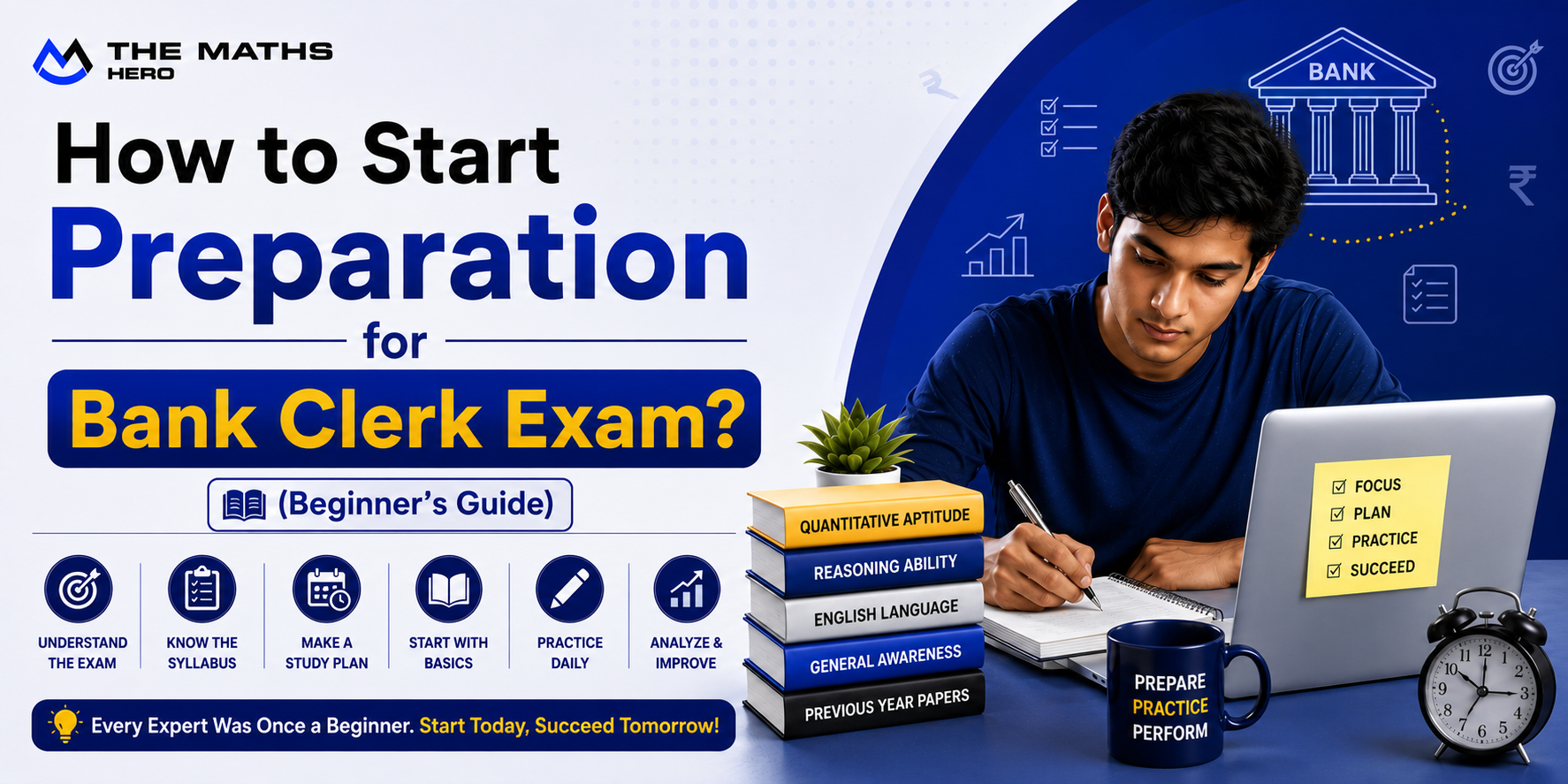
How to Start Preparation for Bank Clerk Exam? (Beginner’s Guide)

15th May 2026

“Success usually comes to those who are too busy to be looking for it.” – Henry David Thoreau
That line fits very well when you think about bank exams, especially the bank clerk exam. Because most students start with confusion, and then slowly they build clarity, and then they move towards success step by step.
If you are wondering how to start preparation for bank clerk exam, then you are already in the right direction. The real issue is not starting, it is starting the right way because many students study hard, but still do not get results, and the reason is simple, lack of proper structure.
This blog will guide you in a simple, practical way so that you understand what to do first, what to avoid, and how to build a strong base.
Understanding the bank clerk exam first
Before you jump into books and notes, you should first understand what the exam actually is.
The bank clerk exam (commonly IBPS Clerk and similar exams) checks your basic skills in reasoning, quantitative aptitude, English,bank clerk exam preparation and general awareness, and it is not about deep knowledge, but it is about speed, accuracy, and practice.
Yes, it looks simple but it is not that easy when you ignore consistency. You have to understand the exam pattern first because without knowing the structure, your preparation becomes random, and that is where most students get stuck.
How to start preparation for bank clerk exam from scratch
Now coming to the main question, how to start preparation for bank clerk exam when you are completely new.
Start like this:
Step 1: Understand the exam pattern and syllabus properly
First, do not rush. Sit with the syllabus. Read it properly. Understand what subjects are there, and what topics are included. Then, divide your preparation into three parts:
- Basics
- Practice
- Revision
Because if you try to mix all together, it will become messy and you will feel lost, so start with basic arithmetic, simple English grammar, and logical reasoning puzzles. Take a notebook, and write all sections:
- Quantitative Aptitude
- Reasoning Ability
- English Language
- General Awareness
If you are starting from zero, then the biggest problem is not difficulty… it is confusion. You don’t know what to do first, and because of that, you either do too much or nothing properly.
Now go deeper. For example, in Quant, you will see topics like simplification, number series, profit & loss, time & work.
Now here is the catch, if you don’t know what “number series” actually involves, how will you prepare for it?
So search each topic, understand what kind of questions come.
👉Mistake to avoid: Do not directly start solving random questions from YouTube or PDFs without knowing the topic. It creates confusion, and you feel like “everything is difficult”.
Step 2: Check your current level
Now before you study seriously, try solving 20–30 questions from each subject, or attempt a beginner-level mock test. You will notice something:
- Maybe you are okay in English
- But very slow in Quant
- Or completely confused in reasoning puzzles
This is important because your preparation should be based on your weakness, not on what you “like”. For example, if you enjoy English, you might spend 2 hours on it daily but if Quant is your weak area and you ignore it, then your overall score will suffer.
Step 3: Start with basic concepts
Many beginners make this mistake. They directly jump into mock tests or advanced questions because they feel the basics are “too easy”. But later they struggle even with simple calculations.
So start properly:
- Learn tables (yes, still useful)
- Practice basic calculations
- Understand simple reasoning patterns
- Learn grammar rules (like tenses, subject-verb agreement)
For example, if you cannot quickly solve 25 × 18 mentally or with short tricks, then DI (data interpretation) will feel very hard later. A good bank clerk exam preparation strategy is not about doing everything, it is about doing the right things repeatedly.
👉Mistake to avoid: Skipping basics because you are in a hurry. That “shortcut” will slow you down later.
Step 4: Create a simple and realistic bank clerk study plan
A bank clerk exam study plan does not need to be complicated. In fact, simple plans work better. You can start like this:
- 2–3 hours daily for beginners
- 1 hour Quantitative Aptitude
- 1 hour Reasoning
- 30–45 minutes English
- 15–30 minutes current affairs
And yes, consistency matters more than long hours. For example, instead of saying “I will study 8 hours daily”, start with 3–4 focused hours and then increase gradually.
Even if you study less, but daily, it works better than irregular heavy study. Also, keep one day weekly for revision and mock tests because without revision, you will forget things, and that has been a common mistake among students.
Step 5: Practice topic-wise questions daily
After learning a topic, immediately solve questions on it, for example, if you studied Profit & Loss today, then solve 20 easy questions, then 20 moderate questions, and then a few tricky ones.
Same goes for reasoning. Start with coding-decoding, then syllogism, and then puzzles because puzzles are time-consuming, and they require patience.
👉Mistake to avoid: Only reading concepts and not practising. You may “understand” it, but you won’t be able to solve under time pressure.
Step 6: Start mock tests early (even if you fail)
Many students think, “I will give mock tests after finishing syllabus” but honestly, the syllabus never really “finishes”. So don’t wait to get it finished and start giving mocks early even if you fail.
Your first few mock tests might feel terrible. You may score low like 40/100 initially, you may make silly mistakes, and that’s okay. But after 2–3 weeks, it should become 55, then 65, and so on. That is progress.
Step 7: Analyze your mistakes
This step is more important than the mock test itself. After every test, sit quietly and check:
- Which questions you got wrong
- Why you got them wrong
- Was it concept issue, speed issue, or silly mistake
If you solved a question correctly but took 2 minutes, that is also a problem because in the real exam, time is limited.
👉Mistake to avoid: Giving mock tests daily but never analyzing them. That is like running without direction.
Step 8: Revise regularly
You might feel like you remember everything, but after a few days, it starts slipping so revision is necessary. Revise formulas weekly. Revise vocabulary regularly. Re-solve previous questions. For example, if you solved a puzzle last week, try solving it again. It will improve your speed.
If you follow these steps properly, your preparation will not feel scattered. It will feel controlled, and yes, if at any point you feel stuck, you can visit TheMathsHero, a best banking preparation platform and explore the best online courses for banking exams, which can help you stay consistent, because sometimes direction matters more than effort.
In the end, starting is simple, but starting the right way, and continuing without breaking the flow, that is what really clears the exam.
How to prepare for bank clerk exam at home
If you are thinking about how to prepare for bank clerk exam at home, then it is completely possible, but discipline is the key. You do not need coaching necessarily, but you do need structure.
Just follow the steps mentioned above, and while staying at home, you can:
- Use online study material
- Watch concept videos
- Practice daily quizzes
- Solve previous year papers
But you should avoid distraction because home environment is comfortable, and comfort reduces seriousness sometimes. So set a fixed study place, fixed timing, and stick to it. That’s it.
What are the best books for bank clerk exam preparation?
Picking up the right books matters a lot and honestly, this is where many students go wrong. Why? Because they keep collecting PDFs, Telegram notes, random recommendations, and then end up studying nothing properly. Relatable right?
You don’t need 20 books. You just need a few reliable ones, and then you revise them again and again. Here are some of the best books for bank clerk exam preparation that actually help:
For quantitative aptitude
- Quantitative Aptitude for Competitive Examinations by R.S. Aggarwal
- Fast Track Objective Arithmetic by Rajesh Verma
For reasoning ability
- A Modern Approach to Verbal & Non-Verbal Reasoning by R.S. Aggarwal
- Analytical Reasoning by M.K. Pandey
For English language
- Objective General English by S.P. Bakshi
- Word Power Made Easy by Norman Lewis
For general awareness (banking + current affairs)
- Monthly current affairs magazines
- Banking awareness PDFs and notes
This section is more about consistency. 15–20 minutes daily is enough but skipping it for weeks is a problem. Also keep in mind that books alone are not enough anymore because bank exams are getting more speed-based and pattern-driven so along with books, you also need structured practice, mock tests, and guidance.
That’s where platforms like TheMathsHero come in. It works like a focused best banking preparation platform, where you don’t just study theory, but also practice questions, take mock tests, and actually track your progress.
For many students, especially beginners, it becomes easier to stay consistent there instead of jumping between different books and sources.
Summing up…
Starting preparation for a bank clerk exam is not difficult but starting it in the right direction matters a lot. If you are serious about it, build your basics first, follow a simple plan, practice daily, and keep improving step by step.
And remember, consistency is more powerful than motivation. Motivation comes and goes but discipline stays.
If you want structured guidance, you should check out TheMathsHero, which is the best platform for banking exam preparation, as they will provide you with the necessary guidance, especially if you find yourself struggling to motivate yourself to study alone. In the end, it is not about how fast you start, it is about how steadily you continue. Good luck!
Recommended for you

Self-Study vs Online Coaching for Bank Exams: What Works Better in 2026?
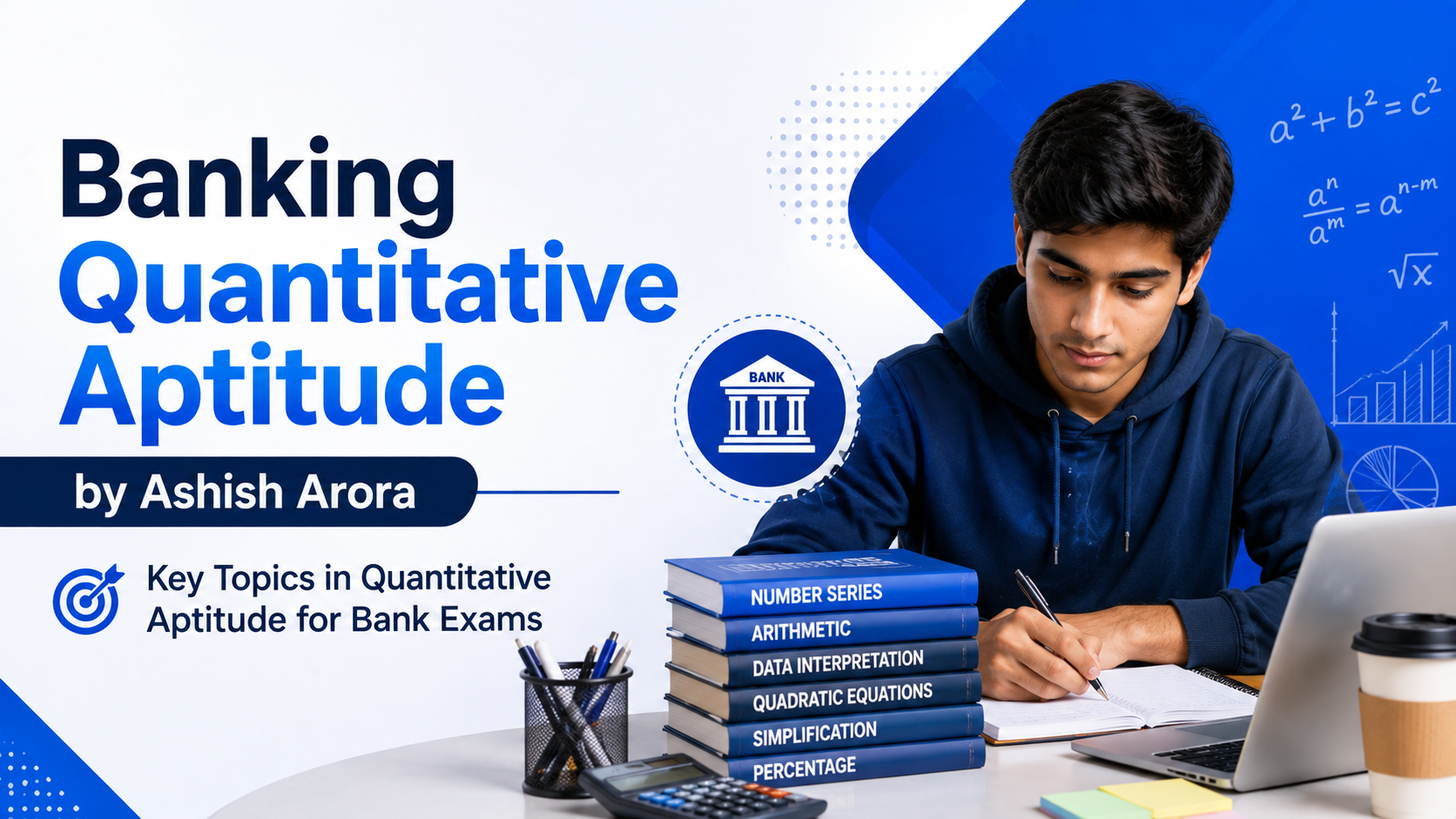
Banking Quantitative Aptitude by Ashish Arora: Key Topics in Quantitative Aptitude for Bank Exams