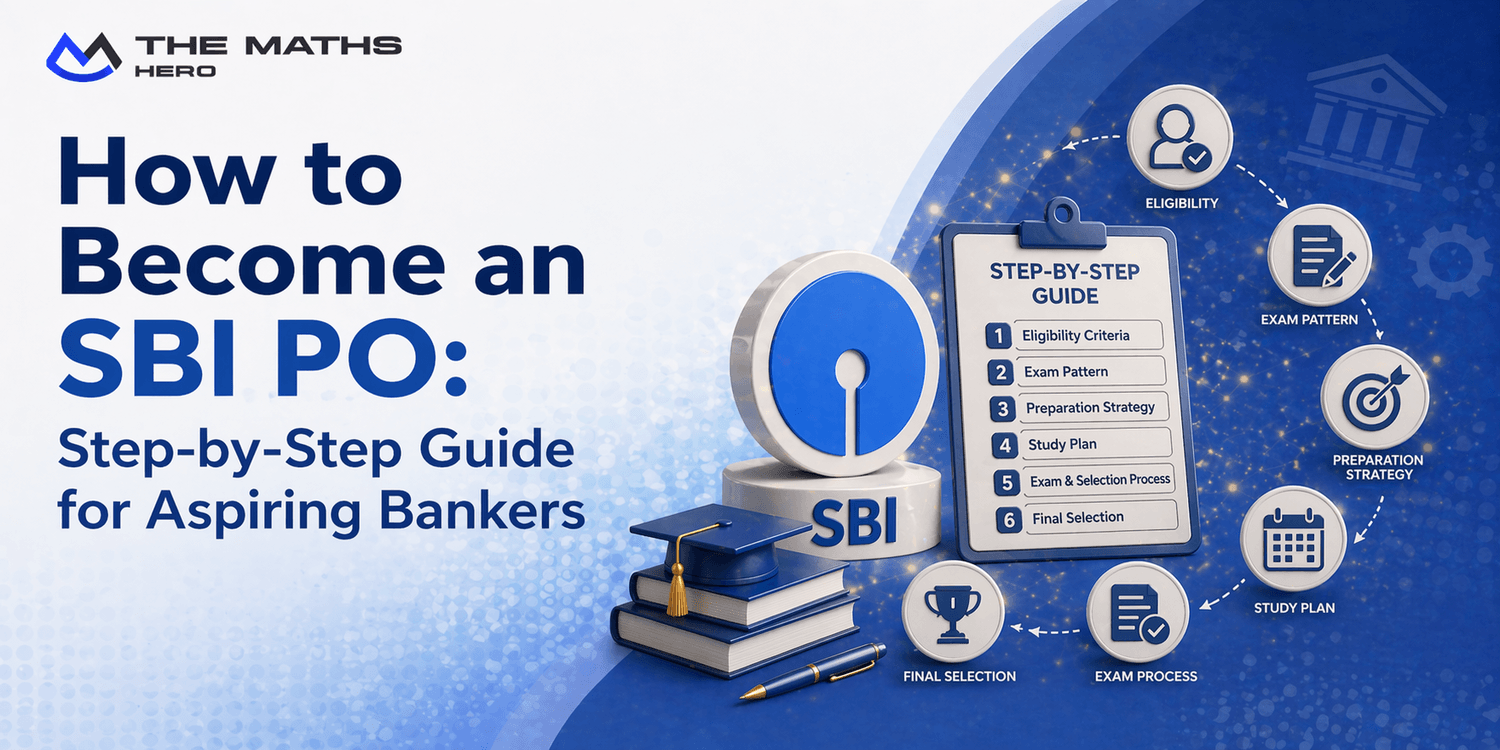
How to Become an SBI PO: Step-by-Step Guide for Aspiring Bankers

22nd April 2026

“How to become SBI PO?”
It’s a question that stays with you and it doesn’t just fade away easily.
Maybe you have asked it after a long day, when the books were open but focus was not really there or when you saw someone else clear it, and it felt motivating, but also a little distant. And sometimes, it just comes up randomly, when you are thinking about your future, and trying to make sense of it.
Because this is not just an exam. It is about stability, and a career that feels secure, and a life that seems more sorted, at least that’s how it looks. But then, there is always that one thought in between “can you really do it?”
You are not alone here.
Every year, lakhs of candidates apply for the SBI PO exam conducted by the State Bank of India, and the numbers have been high, often 8–10 lakh applicants for limited seats. So yes, the competition is tough but it is not impossible.
And that’s where you need to pause and think that it is not about being extraordinary, but about understanding the process, and how you approach your SBI PO preparation, because that is what really matters in the long run.
So if you have been trying to figure this out, and things feel unclear right now, this guide will help you move forward, step by step, in a way that actually makes sense.
Step-by-Step Guide for Aspiring Bankers on How to Become an SBI PO
Below is a path that you follow step by step, and it will help you understand the process better, so that you are not just studying randomly but actually moving with some clarity. So let’s get started:
Step 1: Understand what an SBI PO actually does
Before you begin the preparation, it is important that you understand the role, because if you don’t know what the job is, then the preparation can feel directionless, and a bit confusing too.
An SBI PO in the State Bank of India starts as a probationary officer, and the role is designed in a way where you learn while working. Instead of sitting good at a computer screen and performing one task repeatedly (like opening new accounts), you will do a variety of things at once. You will handle customers, their queries, and sometimes complaints as well. You will also manage accounts,
and deal with banking operations, and in some cases, even loans and approvals. So yes, the responsibility is there, and it builds up over time.
But it does not stay limited.
Once you reach senior levels of PO (Senior PO, Assistant Manager, Manager, etc.), your responsibilities will continue to grow; you will become a leader of a small team, make decisions when the situation is somewhat unclear and sometimes have limited time available to make those decisions. Therefore, this is not a sit-at-the-desk type job but rather an opportunity to develop patience, learning and the ability to work through stressful situations as you grow as an employee.
Step 2: Check SBI PO eligibility criteria
Now before you go deep into your preparation, you should check the basics, because it is important, and you don’t want to miss something simple that could affect your attempt later.
The SBI PO eligibility criteria is not very complicated, but still, you should go through it properly just to be sure.
Educational Qualification
You need to have a graduation degree in any discipline from a recognised university, and if you are in your final year, you can still apply but you must have proof of passing when it is required later.
Age Limit
You should be at least 21 years old, and not more than 30 years, although there are relaxations available, and those depend on your category, so you should check that as well.
Nationality
You must be an Indian citizen because that is a basic requirement for the role.
The criteria is simple and clear but it matters because once you are sure that you are eligible, you can move ahead with your preparation.
Step 3: Know the SBI PO selection process
Now once you are sure that you are eligible, the next thing you need to understand is the selection process because it is not just one exam, it is a series of stages, and each stage is important.
The SBI PO exam is a structured selection process conducted by the State Bank of India, which is a series of steps that applicants must follow to be considered for participation in the position. To be a successful applicant, applicants must be able to demonstrate their preparedness for these steps by consistently meeting the criteria for each successive step.
- The first step is the Preliminary Examination, which is referred to as the ‘screening process’ and is relatively easy compared to the other stages. This is the first examination that you will be required to take. You attempt it, and if you clear it, then you move to Mains.
- Then comes the Mains exam, and this is where things become more serious, more detailed also, and yes, it was always considered the real filtering stage.
- As such, once you pass the main exam, there are two additional aspects of the selection process: Interview and Group Exercise. Interview and group exercises are not just an evaluation of the application knowledge that you possess – these activities are also an evaluation of how you respond to and communicate during your interview or group exercise, and, in addition, your behaviour when subjected to pressure. Thus, your personality is an important consideration in this decision.
- And finally selection is done based on Mains + Interview, combined score, therefore nothing is isolated.
Step 4: Understand SBI PO syllabus and exam pattern
Now this step is very important, because if you don’t know what is inside the exam, then you may study anything and everything and that does not help much, right?
The SBI PO syllabus and exam pattern is divided into 2 main stages – Prelims and Mains, and both are different in nature.
- Prelims
In Prelims, you have English Language, Quantitative Aptitude, and Reasoning Ability and it was designed in a way so that speed and accuracy are tested, not depth.
- Mains
But in Mains, it changes completely, and you are dealing with Data Analysis, Reasoning, General Awareness, English, and also Descriptive writing such as essays, letters and all that, so that your thinking and expression both are checked.
And time is always running so you are not just solving, you are managing time also which makes it slightly tricky but manageable with practice.
Therefore once you understand the pattern properly, your preparation becomes more focused and less random, and that is where improvement starts showing.
Step 5: Build a realistic SBI PO preparation strategy
Now this is the step where many aspirants get stuck, because SBI PO preparation is not about doing everything, but doing the right things consistently.
- So you always start with basics because if concepts are weak, everything else becomes difficult later, and that is just how it is.
- Then you move into practice, and not random practice, but structured one, where you are actually seeing progress, and identifying mistakes.
- Mock tests are also important here, very important actually but they are useful only when you analyse them, because just giving mocks without review was never enough.
- And current affairs, they have been a constant part of Mains, so you cannot ignore them, even if you want to.
So your strategy should not be complicated. It should be simple, realistic, something you can follow daily, even on low-energy days, because consistency is what actually takes you forward, not bursts of motivation.
Step 6: Use the right resources
Now this is something where many aspirants get confused, because there are so many books, apps, videos, and courses and everything looks important, but not everything is useful for you.
So you need to choose carefully, because your SBI PO preparation depends a lot on what you study and what you avoid. Start with limited but reliable books, and stick to them. Don’t keep switching again and again, because that only creates confusion, and slows you down. Then add mock tests, and practice sets but make sure they are relevant to the latest exam pattern, because outdated material was never helpful for SBI PO.
And yes, you can also use the Best SBI PO preparation course if you feel you need structured guidance, because sometimes a proper roadmap and regular practice support can make your preparation more focused, and less scattered.
So the idea is simple: fewer resources, but better quality, so that your time is used in the right direction.
Step 7: Prepare yourself for the interview stage
The next step after completing the written tests is the interview process where you will be evaluated not for your ability to solve problems but rather for who you are as an individual.
The SBI PO selection process uses the interview process to evaluate such things as how well you communicate, who you are as an individual, and what your thought processes are like when under pressure.
While you may know the answers to some of the questions, your ability to articulate those answers, as well as how confident you are in answering potentially surprise questions, will determine your overall success.
It is important to prepare adequately for the fundamentals of your graduate coursework and keep current with current events and banking regulations. You should also practice your communication skills, since hesitation may have a negative impact on your overall impression than wrong answers.
Remember that your goal is to be able to express yourself clearly, remain composed, and exhibit knowledge of what you are stating, rather than trying to be perfect.
Step 8: Stay consistent (even when motivation drops)
As Thomas Edison once said, “Many of life’s failures are people who did not realise how close they were to success when they gave up.”
This step is going to determine almost everything about your preparation, including the strategy you chose to use (which sometimes can be even more important than how much effort you are willing to put towards your preparation). At times, your SBI PO preparation will be very enjoyable, but you will also experience times when you will not feel like preparing for the exam (and therefore want to skip it), so it will be consistency that will keep you motivated to continue taking steps forward, no matter how slowly they happen.
You will not always be able to study effectively, and that is perfectly okay. However, even if you are only able to do a little studying each day, you must continue to show up and keep that consistency going so that you are building on previous learning experiences.
You will face challenges, and you will have to manage your expectations, and you will feel pressure; all of this is an expected part of this experience and is therefore a part of the preparation process that the vast majority of people who eventually pass went through as well.
So, at the end of the day, you continue to work hard day by day, step by step, because the journey is about continuing to move forward at a steady pace (not necessarily at a fast pace).
Common mistakes to avoid
Most aspirants don’t really focus on mistakes they make in the beginning, and that is where the problem starts, because later they realise it mattered more than expected.
Because SBI PO preparation is not only about what you study, but also about what you avoid, and that is something people understand a bit late.
Mistake 1 – Starting without understanding the exam
Many aspirants directly start studying books and mocks, but they don’t actually understand the SBI PO syllabus and exam pattern, and therefore the preparation becomes scattered, not structured. And it was seen many times that without clarity, you are just studying more, but not improving properly.
Mistake 2 – Ignoring the basics
You may feel like jumping to advanced questions quickly, but the truth is – if basics are weak, then everything else becomes difficult, and slow, and sometimes frustrating too. So skipping fundamentals was never a good idea, even if it feels boring at the start.
Mistake 3 – Not analysing mock tests
Mock tests are important, yes, but just giving them is not enough, because if you are not checking mistakes, and not understanding why they happened, then improvement does not really happen. Therefore, mocks without analysis are just practice without direction.
Mistake 4 – Leaving current affairs for later
Many students think they will do it at the end, but current affairs are something that have been building daily, and so waiting for later only creates pressure. It should be small, but consistent because that is how it works better.
Mistake 5 – Random study without plan
Studying anything at any time feels like progress, but it is not always effective, and therefore many aspirants end up repeating topics they already know, while ignoring weak areas. So without structure, effort gets wasted slowly but surely.
Mistake 6 – Comparing your journey with others
This is a very common mistake, but also a silent one. You see others progressing, and then you start questioning yourself, and your own pace, and sometimes it is not just friends or classmates, but even parents compare (intentionally or unintentionally) saying things like “someone else has already cleared this stage” or “they are doing better,” and it sticks with you more than it should.
But their speed, their score, their timeline… it was never your measurement, and it was never meant to be the same. So comparing only adds pressure, and reduces focus, and it makes your preparation feel heavier than it actually is.
So just avoid confusion, stay consistent, and follow a clear path, because that is what actually going to make a difference in your SBI PO preparation over time.
To sum up
So, how to become SBI PO is not one big leap; rather, a series of small steps that you take one after another. The initial step is to checking SBI PO eligibility criteria, then understanding the actual SBI PO selection process. Finally, get clear on the topics covered on the exam itself, as well as the format of the exam to have a clear path in front of you and not a random one.
Your SBI PO preparation depends largely on how often you study, the quality of your practice, and your conduct regarding common errors.
If you’re at the start of your journey towards becoming an SBI PO, it may seem like a long way to go; however, it can be accomplished by taking action and following directions on a step-by-step basis with both discipline and patience.
We wish you all of the best – stay motivated, remain dedicated to your studies, and continue to make advancements on this journey!
Recommended for you

Self-Study vs Online Coaching for Bank Exams: What Works Better in 2026?

Banking Quantitative Aptitude by Ashish Arora: Key Topics in Quantitative Aptitude for Bank Exams