Banking Exam Eligibility Criteria Explained: Age, Qualification & Attempts

26th May 2026

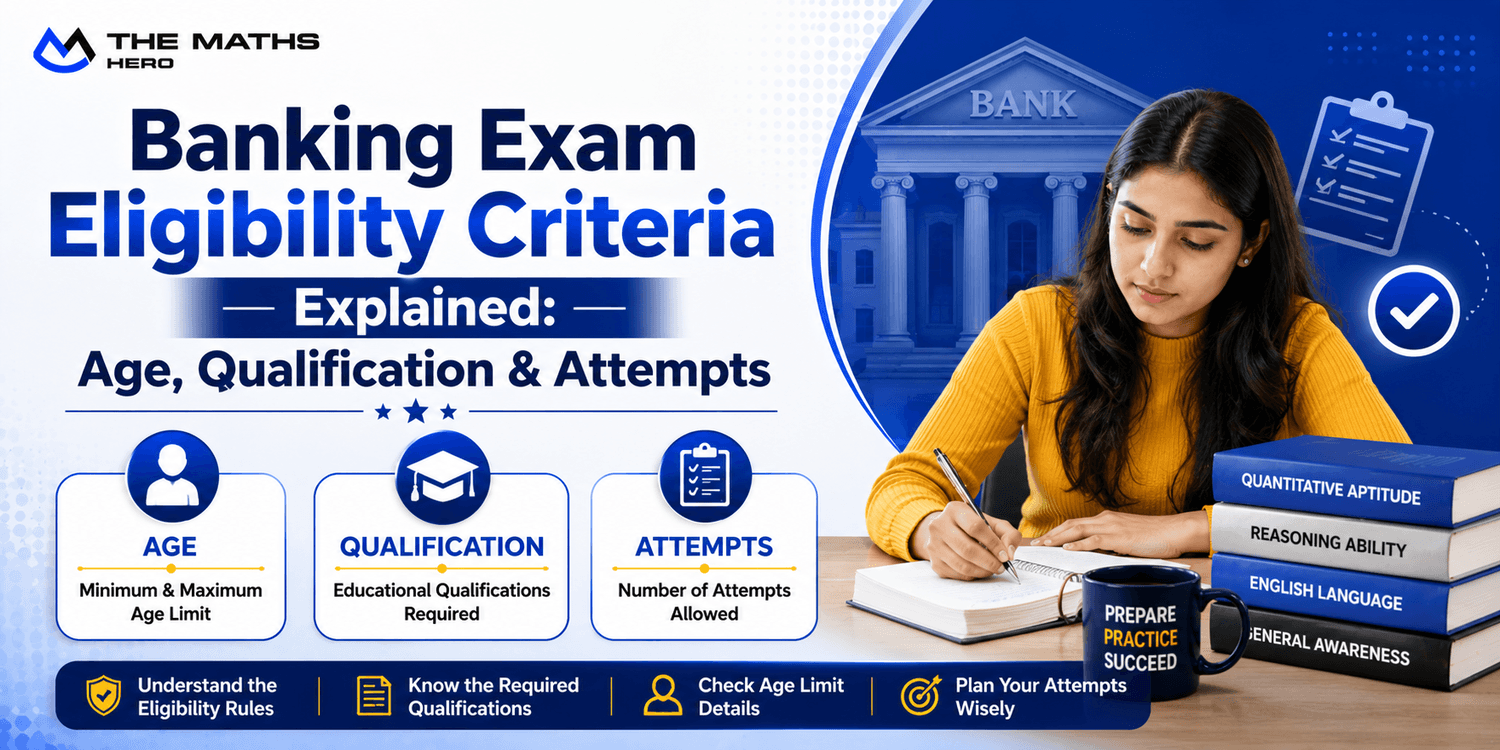
Each year, a vast number of students across India dedicate themselves to preparing for bank entrance evaluations, aspiring to attain a secure and esteemed public sector position. Exams such as IBPS PO, SBI Clerk, RBI Assistant, and IBPS RRB draw in applicants from diverse academic disciplines. However, a significant number of students start their preparation without a complete understanding of the qualifying criteria. Therefore, for banking exam eligibility, it is necessary for banking candidates to go through this blog.
Why Eligibility Criteria Matter?
Banking examinations are characterised by intense competition. Given that numerous aspirants apply for a finite number of openings, the recruiting bodies enforce rigorous eligibility parameters. These regulations serve to ensure that only appropriate candidates proceed through the selection stages.
- If a student fails to meet even one eligibility condition, the application can be rejected at any stage of the selection process.
- In some cases, candidates may successfully clear the written examination but still get rejected during document verification.
- This usually happens because they misunderstood or misinterpreted the eligibility criteria while applying.
- Therefore, having a clear understanding of the rules beforehand helps avoid such problems.
- It ultimately saves both time and effort during the preparation and selection process.
Basic Eligibility Criteria For Banking Exams
Although different banking exams have slightly different requirements, most follow a similar structure. The major areas consist of:
- Nationality
- Educational Qualification
- Age Limit
- Computer Knowledge
- Language Proficiency
Educational Qualification For Banking Exam Eligibility
A university degree is a key requirement for most bank entrance tests. Typically, applicants need a bachelor’s degree from an accredited institution. Individuals with degrees in Arts, Commerce, Science, Engineering, or Management are usually considered qualified. Nonetheless, it’s advised that applicants thoroughly review the official announcements, as certain exams may have further academic requirements. Some of the things to consider for banking exam eligibility include:
- Aspirants must hold a bachelor’s degree from a recognised university.
- Most banking entrance exams welcome applicants from all academic backgrounds.
- Final year students may apply only if permitted in the official notification.
- Certain specialised banking roles might require advanced degrees or particular fields of study.
Banking Exam Eligibility Age Explained
Age criteria often create confusion among students. Banking exams have minimum and maximum age limits that vary according to the post. This is what the age eligibility criteria for banking exams in India look like:
| Exam | Minimum Age | Maximum Age |
| IBPS Clerk | 20 Years | 28 Years |
| IBPS PO | 20 Years | 30 Years |
| SBI PO | 21 Years | 30 Years |
| SBI Clerk | 20 Years | 28 Years |
| RBI Assistant | 20 Years | 28 Years |
Number of Attempts
In contrast to UPSC examinations, a good number of banking exams don’t impose a set number of chances. Candidates are free to take the exams as often as they wish, provided they fall within the banking exam eligibility age.
This gives candidates flexibility and reduces pressure. Many individuals who now work in banking successfully passed their exams after several tries, as gaining experience tends to enhance the effectiveness of their preparation.
The MathsHero: Helping Banking Aspirants With Bank Exams In India
At The MathsHero, students get expert guidance, a systematic curriculum, and test-oriented training, all precisely tailored for demanding banking entrance exams. Covering everything from understanding eligibility requirements to excelling in Quantitative Aptitude, The MathsHero helps candidates to prepare effectively and stay away from regular errors throughout their application journey. Regardless of whether you’re new to this or a returning candidate, the service provides suitable coaching to elevate your level of understanding.

The Final Word
Banking exams like IBPS PO, SBI Clerk, RBI Assistant, and IBPS RRB draw in a vast number of aspirants annually. This is due to their job stability and prospects for career improvement. However, many students overlook the importance of understanding the criteria for bank exam eligibility. Key eligibility factors include nationality, academic background, age restrictions, computer literacy, and language proficiency. Applicants are urged to thoroughly examine the official announcements to prevent disqualification during the document check phase.
FAQs
Q) Can students from any stream apply for banking exams?
Ans) Yes, students from Arts, Commerce, Science, Engineering, and Management backgrounds can apply for most banking exams.
Q) Is computer knowledge necessary for bank exams?
Ans) Yes, basic computer knowledge is important because banking operations are technology-based.
Q) Can candidates apply for banking exams multiple times?
Ans) Of course! Most banking exams do not have a fixed number of attempts as long as candidates meet the age criteria.
Q) How does The MathsHero help banking aspirants?
Ans) The MathsHero provides expert mentorship, structured preparation, practice sessions, and exam-focused training to help students succeed in banking exams.
Recommended for you

Self-Study vs Online Coaching for Bank Exams: What Works Better in 2026?
Banking Quantitative Aptitude by Ashish Arora: Key Topics in Quantitative Aptitude for Bank Exams