Bank Exam Preparation for Beginners: How to Start and Stay on Track

6th May 2026

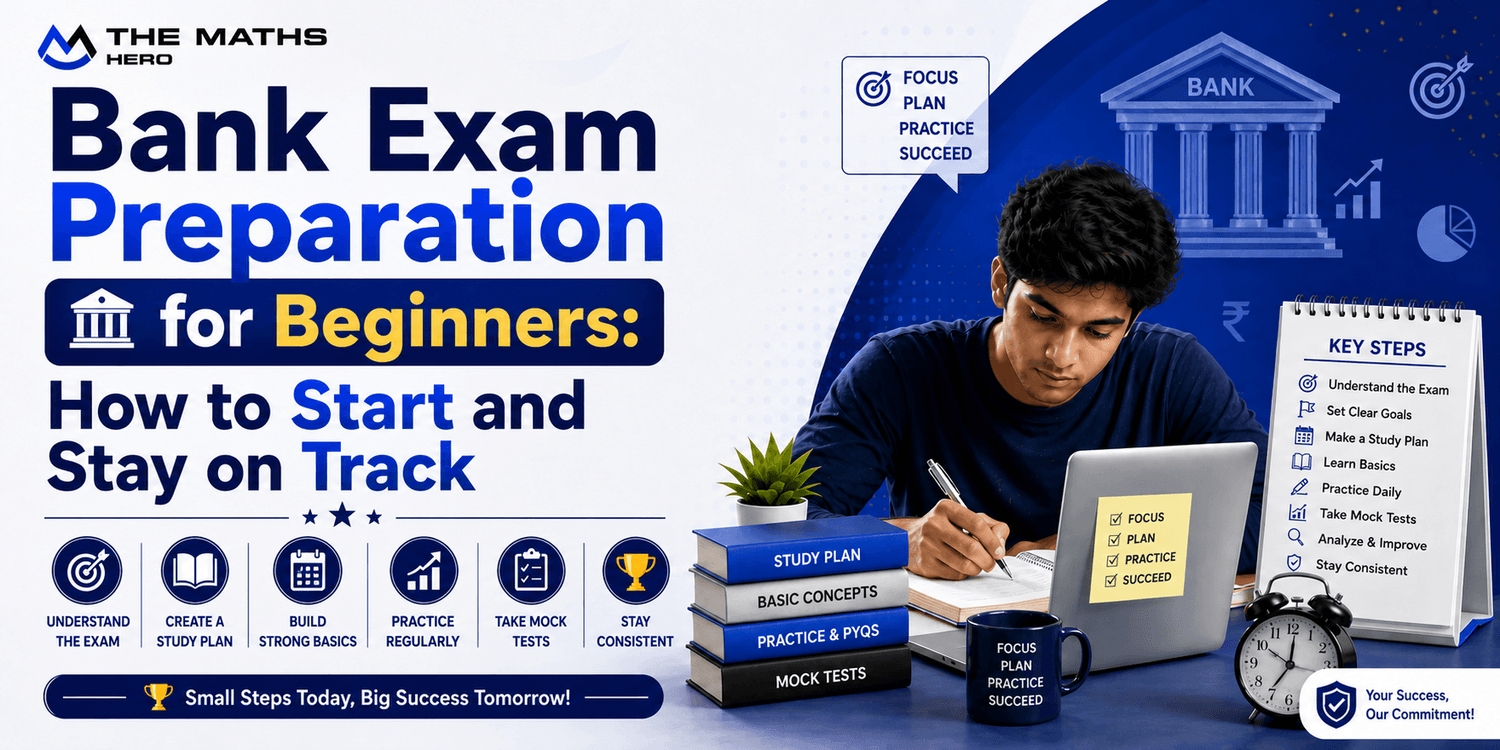
Bank exams are among the most popular career paths in India, especially for students who want a stable government job, a good salary, and long-term security. But a very common question beginners ask is: “Can I really crack bank exams if I start from zero?”
The answer is simple: yes, absolutely. But the real difference comes from how you prepare, not just how much you study. This is where structured banking courses and a proper strategy for bank exam preparation for beginners can completely change the game.
Let’s break it down in a practical way.
An Overview of Banking Courses and Their Value
Banking courses are structured learning programs that are made to guide you step by step through the full bank exam syllabus. Instead of you trying to figure out what to study next and getting confused, it gives a clear roadmap so that bank exam preparation for beginners becomes more simple, and less stressful overall.
The courses cover all major subjects that are needed in bank exams like Quantitative Aptitude, Reasoning Ability, English Language, and General Awareness, so nothing important is left out. And because of this, you are able to stay aligned with the real exam pattern, there is less guesswork.
One of the main things is concept clarity. The topics are explained in a very simple way, but sometimes also in detail, so that even if you were weak in basics earlier, you start building strong fundamentals now. It is not just shortcuts – actual understanding is there.
Finally, there are also guidance systems like performance tracking, doubt solving, and progress checks, which keep you consistent. Sometimes you feel stuck, but then feedback comes in and you move again. This support is what makes the preparation more stable and focused overall.
Can Beginners Really Crack Bank Exams with Banking Courses?
Yes, and here’s why:
1. Courses start from the basics
Good banking courses begin with fundamentals like:
- Percentages in Quant
- Simple puzzles in Reasoning
- Grammar basics in English
So even if you are weak in Maths or English, you are not left behind.
2. Step-by-Step Learning Path
Instead of random preparation, courses follow a sequence:
- Concept building → Practice → Mock tests → Revision
This helps beginners avoid overwhelm and build confidence gradually.
3. Exam-Oriented Practice
Banking courses focus only on what is needed in exams.
No unnecessary theory. Just:
- Frequently asked questions
- Previous year patterns
- Important shortcuts
This makes bank exam preparation for beginners much more efficient.
4. Time Management Training
Most beginners fail not because they don’t know the answers, but because they run out of time.
Courses teach:
- How to solve questions quickly
- Which questions to skip
- How to attempt mocks strategically
This is a major advantage.
Key Subjects You Must Focus On
If you are starting your bank exam preparation, you must understand the four core areas:
1. Quantitative Aptitude
This includes:
- Simplification
- Number series
- Data interpretation
- Arithmetic (percentages, profit-loss, time & work)
👉 This section improves with practice more than theory.
2. Reasoning Ability
This includes:
- Puzzles
- Seating arrangement
- Coding-decoding
- Syllogism
👉 This section tests logical thinking and pattern recognition.
3. English Language
This includes:
- Reading comprehension
- Error spotting
- Cloze test
- Vocabulary
👉 Daily reading helps a lot here.
4. General Awareness
This includes:
- Banking awareness
- Current affairs
- Static GK
👉 This is mostly memory-based and improves with revision.
Smart Strategies for Bank Exam Preparation for Beginners
If you are just starting, follow this simple roadmap:
Step 1: Understand the Exam Pattern
First, you spend like 2–3 days and you just go through the syllabus and exam pattern. The idea is simple but important, because if you don’t understand it first, then everything else will be confusing and messy. So you start there, and you get clarity. And because of that, bank exam preparation for beginners feels more grounded.
Step 2: Start with the basics
Then you move to the basics. And you don’t rush, you really don’t. One topic at a time… slow, steady. Because if you try everything together, it is just an overload, and nothing sticks properly.
Step 3: Practice Daily
After that, daily practice comes in. You do 2–3 hours maybe, or sometimes more or less, but consistency is what matters. You are not just studying, you are building a habit. And because of that, concepts have been getting stronger over time.
Step 4: Take Weekly Mock Tests
Then mock tests. Weekly ones. You take them, and it feels like real exam pressure. But the key thing is not just taking them. It is checking mistakes. Because if mistakes were ignored, then improvement doesn’t happen, right?
Step 5: Revise Regularly
Finally, revision… again and again. You go through what you studied. It does feel repetitive sometimes, but that is exactly the point. Because revision is what turns learning into memory, and therefore what you have studied stays with you for a much longer time, not just for a day or two, but properly.
The Maths Hero: Bringing Direction to Your Bank Exam Preparation
When you are starting out, the biggest challenge is not the syllabus, but the lack of direction – and because of that, a lot of time gets wasted, and things start to feel confusing. themathshero gives you that direction, so that you are not just moving randomly, but actually moving with a plan.
You are not just learning the topics, you are actually understanding how to approach the questions and how to think when the pressure is there. Because of that, you start noticing how you improve with every attempt… even if it feels slow at first.
This approach comes from Aashish Arora’s way of teaching, where the focus is on clarity first, and then practice, and then strategy… because all three are needed, not just one.
So why wait? Start your bank exam preparation the right way with The Maths Hero by your side.
Final Thoughts
Ultimately, succeeding on the bank exams isn’t some grand, spectacular event, but rather the outcome of consistently executing the little tasks correctly. You commit, you learn, you make mistakes, but then you correct those errors, and gradually, without conscious awareness, proficiency develops.
The pace might not seem rapid, and there will be days when progress feels absent, but advancement is occurring. Because every notion grasped and every problem solved correctly accumulates over time. And then, on a certain day, what once seemed obscure begins to feel comfortable… almost intuitive.
FAQs
Which section is the most difficult for beginners in bank exams?
It depends, because for some beginners, Quant feels tough, and for others, it is Reasoning or English. There isn’t one fixed section… it varies. Most of the time, the difficulty is not the subject itself, but the lack of practice and clarity, and because of that it feels harder than it actually is.
How many hours should a beginner study daily for bank exams?
There isn’t a fixed number, and it actually varies from person to person. But generally, 2–4 hours of focused study is enough in the beginning, because what matters more is how you study, not just how long. You can even study less sometimes, but if you are consistent and you revise properly, then the progress will still be there… slowly, but steadily.
Do beginners need banking courses for bank exam preparation?
They are not compulsory, but they have been very helpful for many beginners. Because banking courses give you structure, guidance and also regular practice, so that you don’t feel lost during preparation. When you are starting out, it is easy to get confused, but with the right course, things are more clear, and therefore the whole preparation process feels smoother and more manageable.
Recommended for you

Self-Study vs Online Coaching for Bank Exams: What Works Better in 2026?

Banking Quantitative Aptitude by Ashish Arora: Key Topics in Quantitative Aptitude for Bank Exams