Puzzle Solving Techniques for Banking Exams: Proven Strategies to Solve Questions Faster

3rd June 2026

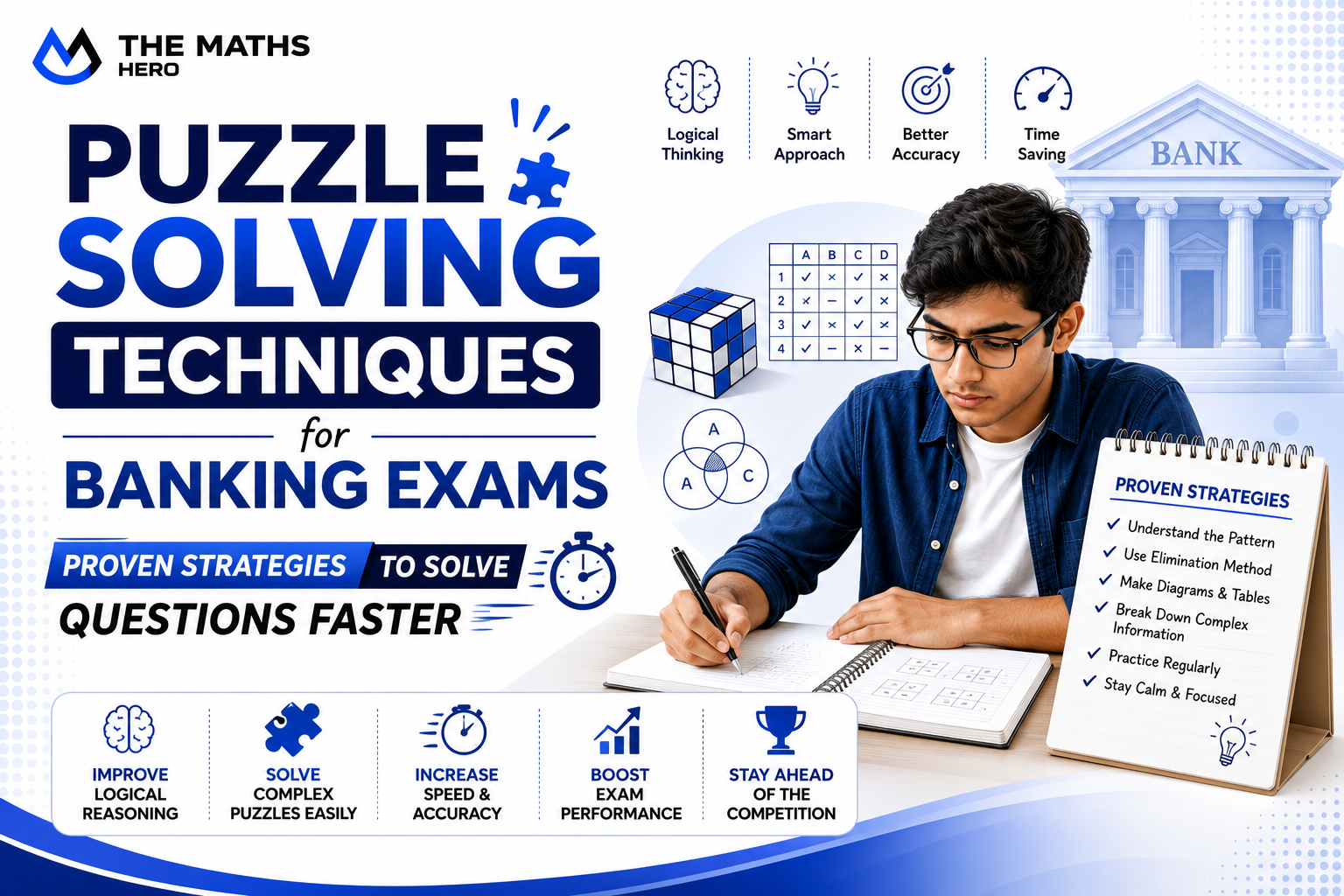
When aiming for bank examinations like SBI PO, IBPS PO Course , or RRB Officer Scale I, you’re undoubtedly familiar with the daunting challenge posed by the Reasoning Ability section. And within that segment, Puzzles and Seating Arrangements stand out as the undisputed champions. So, if you’ve ever found yourself perplexed by a floor-based puzzle involving multiple elements, feeling the pressure as time goes by, this guide from The MathsHero is designed for you. Let’s explore proven, student-vetted methods to master bank exam puzzles while maintaining your composure.
The Anatomy of A Banking Puzzle
Before going deep into strategies, let’s examine what you are facing. Exam setters frequently combine various types to catch you off guard. The most prevalent formats include:
Linear & Parallel Seating
Individuals positioned in a line, some oriented Northwards, others Southwards. Alternatively, two parallel lines facing one another.
Circular & Polygonal Arrangements
Seating arrangements around a circular, square, or triangular table, with individuals facing inwards, outwards, or a mix of both.
Scheduling Puzzles
Events are arranged by days of the week, months of the year, or specific dates (for instance, the 7th and 12th of several distinct months).
Floor & Box Puzzles
People are arranged on different levels of a building, or boxes of varying colours/brands stacked vertically.
Matrix/Uncertain Puzzles
The notorious “a certain number of people” puzzles, where the total count remains unknown until the problem is fully solved.
Step-By-Step Technique To Crack Any Banking Puzzle
When you encounter a puzzle, your mind instinctively urges you to jump in and start sketching. Take a moment to pause. Instead, adhere to this methodical framework.
The First Scan (“The Read Through”)
Dedicate the initial 15 – 20 seconds to reviewing the entire puzzle without making any marks. Your objective isn’t to find the solution at this stage, but rather to understand the central concept and the quantity of elements involved.
Tip: Identify the foundational element of the puzzle. If it relates to months, the months serve as your unchangeable foundation. If it concerns floors, the floors (numbered 1 through 8) are your base.
Establishing The Base & Tables
Construct your fundamental layout promptly. For an 8-floor puzzle, list the numbers 8 down to 1 vertically. If it involves a circular arrangement, sketch a circle with 8 radial lines.
The Golden Rule: Always prepare for two potential scenarios (cases) from the outset. Resist the urge to force all information into a single diagram by repeatedly erasing and redrawing; this squanders valuable time. Set up Case 1 and Case 2 adjacent to each other.
Interpreting the Hints: Explicit vs. Implicit
As you go through the statements, classify them mentally:
Direct Clues: “A resides on the third level.” or “B is seated three positions to the right of C, who faces the core.” Record these on your diagrams without delay.
Indirect/Connecting Clues: “Two individuals are positioned between A and the person who favours Blue.” If the location of A is not yet determined, jot this down in a condensed form on the periphery of your page.
Negative Clues: “P does not occupy an even-numbered level.” Write P ≠ Even directly beside your primary diagram to prevent unintentional placement later on.
The Art of Eliminating Cases
When you enter the brief hints into your two scenarios, one of two outcomes will occur: either one scenario will readily accept the information, or one scenario will strongly conflict with a hint (for instance, you are required to put someone on level 5, but it’s already taken).
The instant a scenario breaks a rule, discard it entirely. Don’t attempt to fix it. Direct all your effort towards the remaining scenario. Should both scenarios reach an impasse, it signifies a misinterpretation of a hint – swiftly review your abbreviated notes instead of rereading the entire passage.
Connecting Thread Method
The most common error learners make is processing Clue 1, then Clue 2, then Clue 3 in sequence. Puzzles are infrequently structured in a chronological order.
If you situated Person A based on a definitive hint, scan the remainder of the puzzle especially for statements that refer to Person A. Discover the linking element. If a hint discusses Person G, but you have no clue about G’s location, bypass that statement for now and seek hints associated with your current information.
The MathsHero: Helping You To Master Any Bank Exam In India
At The MathsHero, we ditch “magic tricks” for genuine, student-approved strategies that enable you to tackle everything from multi-variable equations to probability problems. Our structured approach teaches you to find the underlying pattern and master simultaneous equation elimination, ensuring you remain calm as the clock winds down. Transform from a perplexed candidate into a strategic solver with the specific techniques used by successful SBI, IBPS, and other banking exam toppers.
So, Start Your Journey To 100% Accuracy – Join The MathsHero Today!
The Final Word
As you begin, puzzles might seem utterly chaotic. You’ll misinterpret hints, your deductions will unravel, and you may doubt your suitability for banking exams.
Every candidate who has succeeded has experienced the very same feelings you’re having. Tackling puzzles is like exercising a muscle; the more you work it out, the more robust it becomes. Begin at a gentle pace, perfect your note-taking system, get comfortable considering various scenarios, and before long, those intimidating grids will start to resolve themselves effortlessly.
FAQs
Q) Why are puzzles important in banking exams?
Ans) Puzzles are a significant component of the Reasoning section in banking exams like SBI PO, IBPS PO, and RRB Officer Scale I. They evaluate a candidate’s capacity for logical deduction, analytical prowess, and efficient time management.
Q) What are the most common puzzle types asked in banking exams?
Ans) Often encountered puzzle types are Linear and Parallel Seating Arrangements, Circular and Polygonal Arrangements, Scheduling Puzzles, Floor and Box Puzzles, and Matrix or Uncertain Number Puzzles.
Q) How should I handle indirect or connecting clues?
Ans) Indirect clues establish connections between various elements, though they might not immediately indicate specific placements. It is advisable to briefly jot them down and refer back once further details emerge.
Q) What are negative clues, and why are they important?
Ans) Negative clues indicate positions where an individual or item is definitively excluded. Documenting these limitations helps in preventing errors and reducing the range of potential outcomes.
Recommended for you

Self-Study vs Online Coaching for Bank Exams: What Works Better in 2026?
Banking Quantitative Aptitude by Ashish Arora: Key Topics in Quantitative Aptitude for Bank Exams