Common Mistakes Students Make During Bank Exam Preparation

1st June 2026

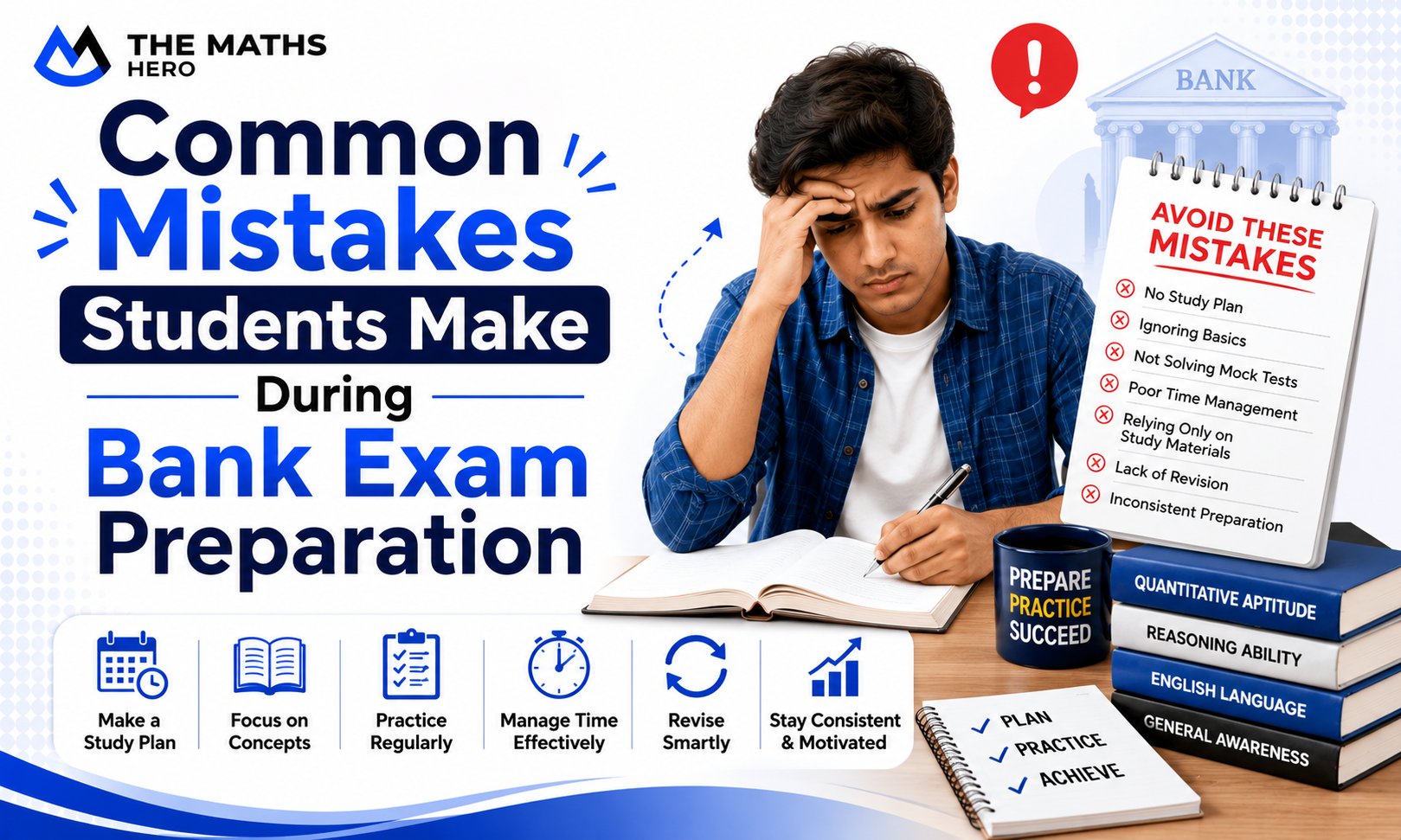
Annually, a multitude of individuals gear up for banking examinations, aspiring to land a secure and esteemed government position. Contests such as IBPS PO, SBI Clerk, RBI Assistant, and IBPS Clerk witness fierce rivalry, and while a great number of candidates apply themselves diligently, not all achieve their intended outcome. The cause isn’t invariably a deficiency in exertion. In numerous instances, individuals commit minor yet significant blunders during their preparation, which impact their performance in the ultimate test.
Starting Preparation Without Understanding The Exam Pattern
Various banking aspirants begin tackling questions haphazardly or emulate others’ strategies without first examining the curriculum and examination format for themselves. Banking assessments typically cover areas like Quantitative Aptitude, Reasoning Ability, English Language, and General Awareness. Certain exams also incorporate Computer Knowledge and essay-style writing. Before starting preparation, spend time analysing:
- The latest syllabus
- Previous year papers
- Section-wise marks distribution
Ignoring Mock Tests In Early Stages
Many individuals shy away from practice tests, feeling “not entirely ready.” This represents a significant misstep. Practice tests are not solely for evaluating progress at the conclusion; they are an integral component of the preparation journey itself. Students who delay mocks often struggle with:
- Time management
- Exam pressure
- Accuracy and speed
Focusing Mainly On Strong Subjects
Each student has subjects that they favour. Some find reasoning enjoyable, while others feel at ease with English or Quantitative Aptitude. Moreover, aspirants tend to dedicate more time to disciplines they already favour. The difficulty arises when weaker areas are completely overlooked. Here, the smarter approach is:
- Maintain strong areas
- Give extra attention to weak subjects
- Practice difficult topics daily in small portions
Studying Without A Proper Time Table
A common issue among aspirants is irregular study patterns. Some individuals study for 10 hours on one day and hardly at all for the subsequent two days. Such inconsistency affects retention and productivity. A well-structured timetable doesn’t mean studying all day. It signifies consistent, disciplined learning. Students should create realistic schedules based on:
- Available time
- Personal strengths
- Daily routine
Relying Too Much On One Source
Many aspiring candidates either constantly switch their study resources or depend solely on one particular source. Both methods have their own difficulties. Some individuals acquire an abundance of books and courses but complete none of them. So, aspirants should:
- Choose limited but reliable sources
- Focus more on practice rather than collecting materials
- Revise concepts regularly
Skipping Revision
Revision is often overlooked during preparation by banking aspirants. Many students absorb new material but rarely revise old concepts. As a result:
- Formulas are forgotten
- Accuracy decreases over time
- Confidence drops during mocks
Not Practising Enough Questions
Understanding ideas is crucial, but bank exams ultimately depend on execution and promptness. A significant number of candidates dedicate excessive hours to lectures and minimal time to problem-solving. Diligent practice is vital as it:
- Improves speed
- Builds confidence
- Reduces silly mistakes
Ignoring Current Affairs Question
Current affairs hold considerable weightage, particularly in the main stages. However, many students postpone preparation for current affairs until the final hour. This strategy rarely works because current affairs require continuous coverage and revision. These aspirants should build a daily habit of:
- Reading current affairs
- Making short notes
- Following banking awareness topics
The Mathshero: Your Mentor To Academic Success
Preparing for bank exams requires the right strategy, consistent practice, and expert guidance. At
The Mathshero, students get structured learning, concept clarity, shortcut techniques, and regular mock practice designed specifically for competitive banking exams. From Quantitative Aptitude to exam-oriented problem solving, every session focuses on improving speed, accuracy, and confidence. Whether you are preparing for IBPS PO, SBI Clerk, RBI Assistant, or IBPS Clerk, Aashish Arora Maths helps you avoid common preparation mistakes and move closer to your dream government job.
So, why wait to make your banking job a reality? Get the best guidance from Aashish Arora Maths and crack the banking code right now.
The Final Word
One of the biggest errors is starting preparation without understanding the latest syllabus, exam pattern, and section-wise weightage. Many aspirants also ignore mock tests during the early stages, which later affects time management, speed, and confidence in the actual exam.
Students often focus only on their favourite subjects while neglecting weaker areas, leading to poor overall performance. Irregular study schedules, excessive dependence on multiple study materials, and a lack of revision also reduce preparation efficiency. Thus, success in banking exams is a balanced approach that is available at Aashish Arora Maths.
FAQs
Q) Why are mock tests important for bank exams?
Ans) Mock tests are beneficial for improving your ability to manage time, increasing your speed, boosting precision, and building confidence when facing examination stress.
Q) How often should students attempt mock tests?
Ans) Learners ought to undertake a minimum of 2 – 3 mock tests each week throughout their study period, and then raise this frequency as the examination date comes closer.
Q) Is focusing only on strong subjects a bad strategy?
Ans) Yes, overlooking subject areas where you are less proficient can lead to diminished overall marks and impact the minimum required scores in specific sections.
Q) How can students improve their weaker subjects?
Ans) Aspirants must work on their weaker subjects every day in manageable segments and continuously review the core ideas.
Recommended for you

Self-Study vs Online Coaching for Bank Exams: What Works Better in 2026?

Banking Quantitative Aptitude by Ashish Arora: Key Topics in Quantitative Aptitude for Bank Exams