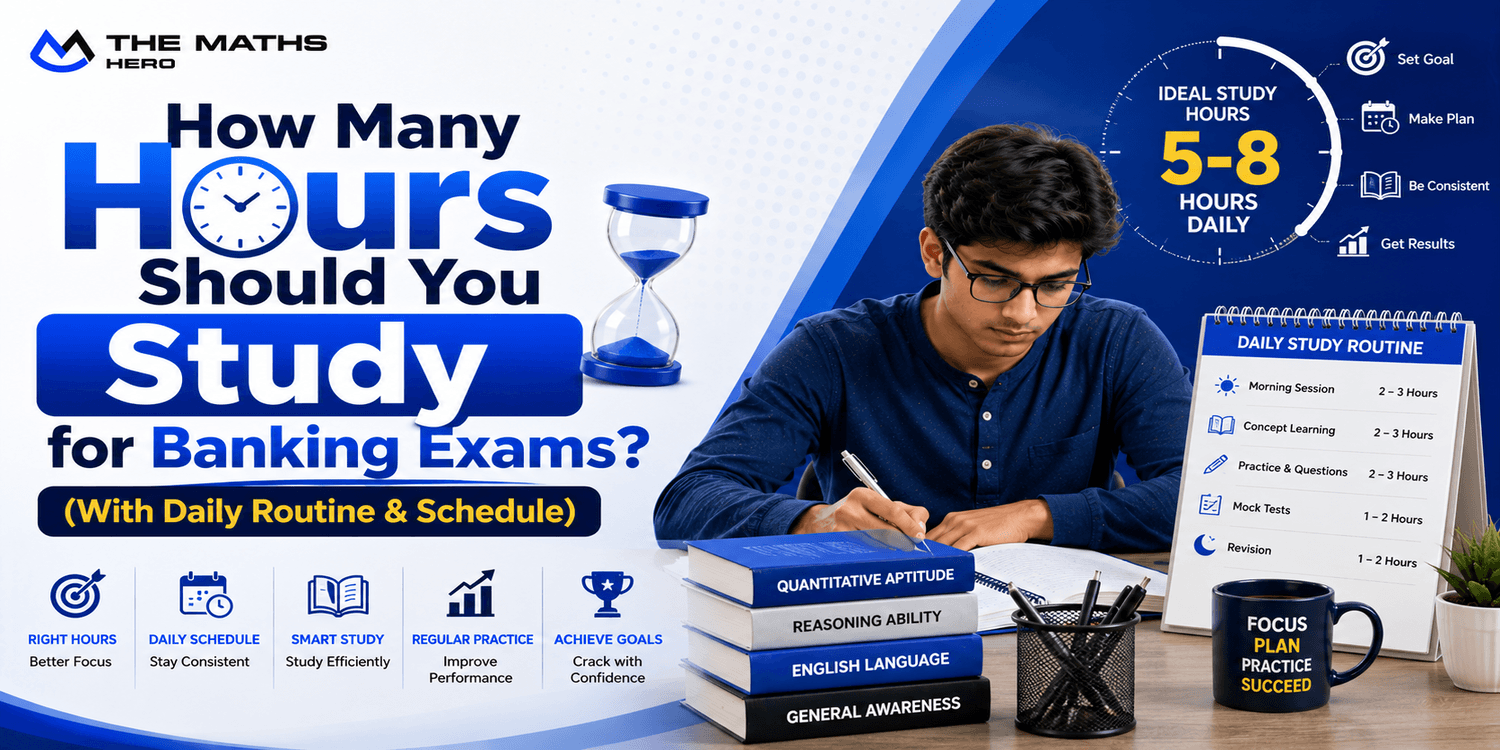
How Many Hours Should You Study for Banking Exams? (With Daily Routine & Schedule)

25th May 2026

If you’re preparing for exams like IBPS PO, SBI PO, or Clerk, you’ve probably figured this out already – it’s not really about how many hours you sit with your books, it’s about how consistently you actually show up.
And then naturally, the question hits: how many hours should you study for banking exams every day?
There’s no perfect number honestly. Anyone telling you “just do 6 hours daily and you’ll crack it” is oversimplifying it. The real answer depends on where you are in your prep. If you are starting out, you’ll obviously need more time to build basics. If you’re already in the practice phase, it’s less about long hours and more about focused solving, mocks, and fixing mistakes.
But here’s the important part: it’s not the total hours that matter as much as how you’re actually using them across subjects and revision. Once you understand that, the whole idea of “fixed study hours” starts to feel a bit overrated.
And that’s exactly where a proper structure comes in…
So how many hours should you study for banking exams?
Most serious aspirants usually land somewhere around 4 to 8 hours a day but that range is not a rule, it’s just a reference point.
Because honestly, your situation decides everything:
- Beginners: 5–8 hours (you’re building everything from scratch, so yes, it takes time)
- Intermediate learners: 4–6 hours (now it’s more about practice than learning concepts)
- Working professionals: 2–4 hours (tight schedule, so every hour has to be sharp)
But here’s the part most people ignore –
It’s not about sitting longer, it’s about staying mentally “in the game” while studying.
Daily study routine for banking exams (that actually works)
Forget complicated timetables. A solid daily study routine for banking exams is really just about balancing your brain load across the day.
Morning (build mode – 2 hours)
This is your fresh brain zone. Use it for Quant or Reasoning.
Don’t just solve – try to understand why a question is solved that way.
Afternoon (push mode – 2 hours)
Now it’s practice time. Puzzles, DI sets, mixed reasoning – the messy stuff. This is where speed starts forming.
Evening (language + awareness – 2 hours)
English + Current Affairs. Read, don’t mug up. Banking exams love people who read regularly, not crammers.
Night (clean-up mode – 1 hour)
This is underrated but powerful. Revise mistakes, formulas, wrong questions, and do a quick mini test.
That’s it. Nothing fancy. Just repeatable structure.
Competitive exam study schedule that separates toppers
Most aspirants don’t fail because they don’t study – they fail because their preparation is random.
A smart competitive exam study schedule looks like this:
- Mon–Wed: Learn + practice new topics
- Thu–Fri: Mixed questions + sectional tests
- Sat: Full mock test (no excuses)
- Sun: Fix weak areas + revise mistakes
And here’s the truth nobody tells you: Mocks don’t improve you. Analysis does.
If you’re not reviewing your mistakes, you’re basically repeating them.
Bank PO coaching classes – Needed or Not?
This is where people overthink.
Should you join bank PO coaching classes? Maybe. Maybe not.
Coaching helps when:
- You need structure because self-discipline is shaky
- You want shortcuts, guidance, and test discipline
- You perform better in a competitive environment
But self-study works just as well if:
- You can stick to a plan without external pressure
- You actually analyze your mocks (not just take them)
- You don’t jump between too many resources
At the end of the day, coaching is a support system. Not a shortcut.
Master maths faster with The Maths Hero classes
Most students preparing for banking exams don’t fail because they can’t do maths, they struggle because they don’t know how to approach it the right way. That’s exactly what we fix at The Maths Hero.
We focus on making Quantitative Aptitude simple, structured, and actually exam-oriented. No unnecessary theory, no confusing shortcuts – just what you need to solve questions faster and more accurately.
With The Maths Hero, you get:
- Clear concept-building from basics to advanced level
- Smart tricks and techniques for faster calculations
- Exam-level practice sets based on IBPS, SBI, and Clerk patterns
- Step-by-step guidance so you always know what to do next
You don’t need more pressure, you need a better way to prepare. So study the better way with The Maths Hero & start seeing real improvement in your scores.
Final thought (Read this twice if needed)
There is no “perfect number” of study hours for banking exams. Not 4, not 6, not 10 – none of that matters as much as people think it does.
What actually makes the difference is how you show up every single day, even on the days when you don’t feel like it, even when motivation is completely missing. Because honestly, banking exam preparation is not a motivation game… it’s a repetition game.
What works is simple, but not always easy:
- Following a proper structure instead of randomly jumping between topics
- Giving equal importance to practice, mocks, and revision instead of just reading theory
- Fixing your mistakes instead of ignoring them and moving on
And over time, this is what actually builds selection-level preparation.
Because banking exams don’t reward the person who studies the most hours or reads the most books. They reward the one who stays consistent, thinks clearly under pressure and keeps improving a little bit every single day – even when progress feels slow.
FAQs
1.How many hours should I study for banking exams daily?
Ans) Most aspirants study around 4 to 8 hours daily, depending on their level. Beginners usually need more time to build concepts, while advanced candidates focus more on practice, mocks, and revision.
2.Is 4 hours of study enough for banking exams?
Ans) Yes, 4 focused hours can be enough if your preparation is structured. The key is consistency, proper revision, and regular mock tests rather than just long study sessions.
3.Can I prepare for banking exams in 3-4 hours daily?
Ans) Yes, you can – but only if your study is highly focused. With limited time, consistency, mock tests, and smart revision matter more than long study hours.
Recommended for you

Self-Study vs Online Coaching for Bank Exams: What Works Better in 2026?
Banking Quantitative Aptitude by Ashish Arora: Key Topics in Quantitative Aptitude for Bank Exams